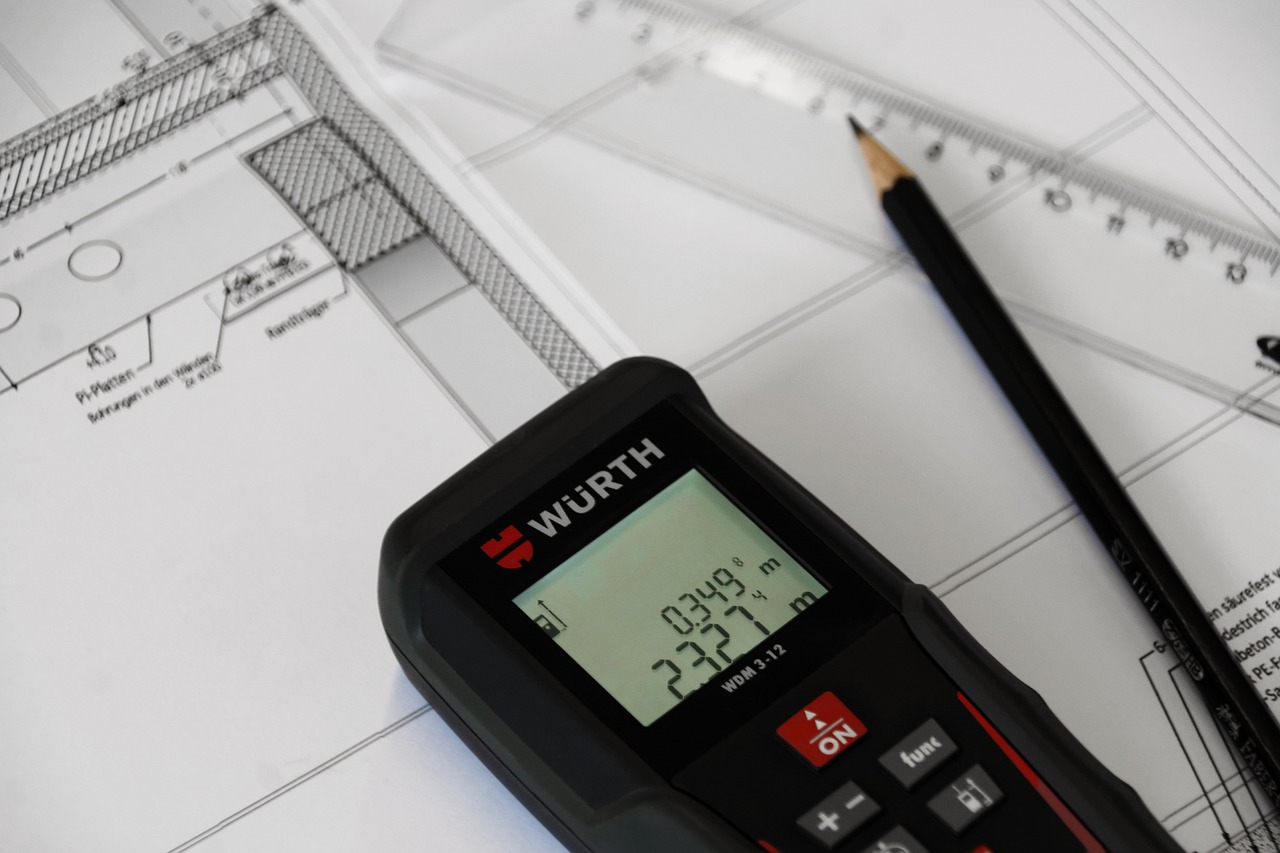
A laser measure is one of the most important tools in property surveying. Whether you are measuring internal room dimensions for a lease plan, checking the extent of a building for a title plan, or surveying a commercial property for a floor layout, a reliable laser measure delivers the speed and accuracy that professional plan preparation demands.
In this guide, we look at the different types of laser measure available, explain how they are used in property surveying, highlight the features that matter most for producing Land Registry-compliant plans, and share what we have learned from using these tools on site for over 30 years.
From our experience: At Towers Richardson, we use professional-grade laser measure devices whenever a property needs measuring. The accuracy of the laser measure directly affects the accuracy of the finished plan — which is why choosing the right tool and knowing how to use it properly matters so much.
What Is a Laser Measure?
A laser measure — also known as a laser distance meter or laser rangefinder — is a handheld device that calculates distance by emitting a laser beam at a target and measuring the time it takes for the beam to return. The result is displayed instantly on a digital screen, giving you an accurate measurement in seconds.
Modern laser measure devices can record distances from around 0.05 metres up to 200 metres or more, depending on the model. Most professional units are accurate to within 1 to 2 millimetres, which is more than sufficient for the vast majority of property surveying tasks.
For property professionals, the laser measure has largely replaced the traditional tape measure for internal surveys. It is faster, more accurate over longer distances, and can be operated by a single person — making it an essential tool for anyone recording internal layouts for lease plans.
How Laser Measures Are Used in Property Surveying
In the context of property surveying and plan preparation, a laser measure is used for several key tasks.
Accurate Measurement for Lease Plans
When preparing a lease plan for HM Land Registry, detailed floor plans showing the internal layout of the property are required. A laser measure allows the surveyor to quickly and accurately record room dimensions, wall thicknesses, corridor widths and the positions of doors and windows. These measurements are then used to produce scaled floor plans in CAD software.
Checking Building Dimensions for Title Plans
While title plans are primarily based on Ordnance Survey mapping data, there are situations where a surveyor needs to verify building dimensions on the ground — for example, where a new extension does not yet appear on the OS map. A laser measure provides a fast way to check these measurements on site.
Commercial Property Surveys
Commercial properties — offices, retail units, warehouses and industrial premises — often need a site visit before a lease plan can be prepared. A laser measure is the primary tool used for capturing these measurements efficiently.
Development Site Surveys
On development sites, a laser measure can be used to check plot dimensions, building setbacks and the positions of key features. While larger-scale site surveys typically use GPS and total station equipment, a laser measure is invaluable for quick on-site checks and internal measurements.
Types of Laser Measure
There are several categories of laser measure on the market. The right choice depends on what you are using it for and the level of precision you need.
Point-and-Shoot Laser Measures
These are the most common type. You point the device at the target surface, press a button, and the distance appears on the screen. Most models in this category have a range of 20 to 60 metres, which is sufficient for measuring rooms and internal spaces. They are compact, affordable and easy to use, making them a good starting point for basic property measurement tasks.
Professional Laser Distance Meters
Designed for surveyors, construction professionals and architects, these devices offer longer ranges (typically 100 to 200 metres), higher accuracy (often ±1.0 mm) and additional functions such as area calculation, volume calculation, indirect height measurement and Pythagoras functions. Professional models from manufacturers such as Leica, Bosch and Stabila are widely used in property surveying.
Bluetooth-Enabled Laser Measures
Many modern laser measure devices include Bluetooth connectivity, allowing you to send measurements directly to a smartphone, tablet or laptop. This is particularly useful when working with survey apps or CAD software on site, as it reduces the risk of transcription errors and speeds up the data capture process.
Laser Measures With Camera Viewfinders
For outdoor use or long-range measurements where the laser dot becomes difficult to see, some models include a built-in camera with a digital viewfinder. This allows you to see exactly where the laser is pointing on screen, even at distances of 100 metres or more. These are useful for surveying large buildings, facades and open sites.
Laser Levels With Distance Measurement
Some devices combine laser measuring with laser levelling functions in a single unit. While these are more commonly used in construction for setting out levels and alignments, they can be useful for surveyors who need both measuring and levelling capability on the same site visit.
Practical tip: For property surveying and lease plan preparation, a professional laser distance meter with Bluetooth is the best all-round choice. The Bluetooth function saves significant time when you are recording dozens of measurements in a single survey, and the professional accuracy ensures your finished plans are reliable.
Key Features to Look For
If you are choosing a laser measure for property surveying work, the following features are worth prioritising:
- Accuracy of ±1.5 mm or better — professional surveying demands precision, and this level of accuracy ensures your measurements translate reliably into scaled plans
- Range of at least 60 metres — sufficient for most internal and external property measurements, though 100+ metres is better for commercial and outdoor work
- Bluetooth connectivity — allows direct transfer of measurements to your phone, tablet or laptop, reducing manual errors
- Area and volume calculation — built-in functions that save time when surveying rooms and calculating floor areas
- Indirect measurement (Pythagoras function) — useful for measuring heights and distances that cannot be reached directly
- Robust build quality — a rubberised casing and IP54 dust and water protection are essential for site use
- Clear digital display — a backlit screen with large, readable digits makes a difference when working in dim or bright conditions
- Measurement from back edge — the ability to measure from the back of the device (rather than the front) is important when measuring into corners
Need a Lease Plan?
Where a property needs measuring for a lease plan, we visit and record the internal layout using calibrated laser measure equipment. 100% HMLR acceptance rate on every plan.
Get a Free QuoteLaser Measure vs Traditional Tape Measure
The traditional tape measure is still a useful tool, but for professional property surveying it has largely been replaced by the laser measure. Here is how they compare:
| Feature | Laser Measure | Tape Measure |
|---|---|---|
| Accuracy | ±1.0 to ±1.5 mm (professional models) | ±1 to ±3 mm (depends on technique) |
| Range | Up to 200+ metres | Typically 5 to 8 metres |
| One-person operation | Yes — point and shoot | Often requires two people for longer distances |
| Speed | Instant readings | Slower, especially over longer distances |
| Data transfer | Bluetooth to phone, tablet or CAD | Manual recording only |
| Curved surfaces | Not suitable | Better for curved or irregular surfaces |
| Cost | £50 to £500+ depending on model | £5 to £30 |
In practice, most surveyors carry both. A laser measure handles the vast majority of measurements, while a short tape measure is useful for small details, curved surfaces and situations where a flat surface to reflect the laser is not available.
How Accurate Is a Laser Measure?
The accuracy of a laser measure depends on the model, the conditions and how it is used. Professional-grade devices are typically accurate to within ±1.0 to ±1.5 mm over their full range. Entry-level consumer models may be accurate to within ±2.0 to ±3.0 mm.
Factors That Affect Accuracy
Several factors can influence the accuracy of a laser measure reading:
- Target surface — the laser works best against flat, solid surfaces. Rough, dark or highly reflective surfaces can affect the reading
- Bright sunlight — strong ambient light can make the laser dot difficult to see and may reduce accuracy at longer distances
- Temperature extremes — very hot or cold conditions can affect the internal electronics of the device
- Obstructions — dust, rain or obstacles in the laser path will give incorrect readings
- Reference point — you need to know whether the device is measuring from its front edge or back edge, and set it accordingly for the situation
For property surveying, the accuracy of a good-quality laser measure is more than sufficient. The tolerances involved in producing lease plans and floor plans are well within the capabilities of professional devices, provided they are used correctly and maintained properly.
Common Mistakes When Using a Laser Measure
Even with a reliable laser measure, errors can creep in if the device is not used carefully. Here are the most common mistakes we see:
- Measuring to the wrong surface — if the laser hits a door frame, skirting board or piece of furniture instead of the wall, the reading will be wrong
- Not checking the reference point setting — most devices can measure from the front or back edge, and selecting the wrong one adds or subtracts the length of the device itself
- Forgetting to account for wall thickness — when measuring between rooms, you need to add the wall thickness to get the overall building dimension
- Taking readings at an angle — the laser must be perpendicular to the target surface for an accurate distance reading, as measuring at an angle gives a longer result
- Not recording measurements systematically — on a complex survey with dozens of readings, it is easy to lose track of which measurement relates to which room or dimension
- Relying on a single measurement — good practice is to take at least two readings for each dimension and check they agree before recording the measurement
These are basic errors, but they can lead to inaccurate floor plans and, in the worst case, plans that do not reflect the true layout of the property. On a lease plan submitted to HM Land Registry, accuracy matters — an incorrect plan can lead to disputes about the extent of the demised premises.
What We Use at Towers Richardson
At Towers Richardson, we use professional-grade laser measure devices whenever a site visit is needed. Our equipment is calibrated regularly and maintained to ensure consistent accuracy across all of our work.
We combine laser measure data with professional CAD software and licensed Ordnance Survey mapping to produce plans that meet HM Land Registry standards under Practice Guide 40. The accuracy of our laser measure equipment is a critical part of that process.
Here is what we offer:
- On-site measurement — using calibrated laser measure equipment for accurate room dimensions and building layouts
- Lease plans — detailed floor plans showing the demised area, communal spaces and access routes, prepared for HMLR registration
- Title plans and transfer plans — based on licensed OS data and verified with on-site measurements where needed
- 100% HMLR acceptance rate — every plan is checked against Practice Guide 40 before delivery
- Fast turnaround — most plans delivered within 24 to 48 hours, with same-day options available
- Nationwide coverage — we prepare Land Registry plans across England and Wales
30+ Years. 100% Acceptance Rate.
Trusted by solicitors, developers and property professionals across England and Wales since 1994.
Request Your Free QuoteFrequently Asked Questions
What is a laser measure?
A laser measure is a handheld device that calculates distance by emitting a laser beam at a target surface and measuring the time it takes for the beam to return. It displays the result instantly on a digital screen, providing fast and accurate distance measurements.
How accurate is a laser measure?
Professional-grade laser measure devices are typically accurate to within ±1.0 to ±1.5 mm. Entry-level consumer models may have an accuracy of ±2.0 to ±3.0 mm. For property surveying and plan preparation, professional models provide more than sufficient precision.
Can I use a laser measure for a lease plan survey?
Yes. A laser measure is the primary tool used for recording internal layouts for lease plans. It allows the surveyor to record room dimensions, wall positions and building layouts quickly and accurately. The measurements are then used to produce scaled floor plans in CAD software.
Which laser measure is best for property surveying?
For professional property surveying, look for a laser measure with an accuracy of ±1.5 mm or better, a range of at least 60 metres, Bluetooth connectivity and a robust build. Professional models from Leica, Bosch and Stabila are widely used in the industry.
Do I need a laser measure to prepare a Land Registry plan?
Not always. Title plans and transfer plans are primarily based on Ordnance Survey data and do not require a site visit in most cases. However, lease plans that include internal floor layouts require a site visit, and a laser measure is the standard tool for capturing those measurements.
Is a laser measure better than a tape measure?
For most property surveying tasks, yes. A laser measure is faster, more accurate over longer distances and can be operated by one person. However, a traditional tape measure is still useful for small details, curved surfaces and situations where a flat target surface is not available. Most surveyors carry both.
How much does a site visit cost?
Where a site visit is required, the cost depends on the size and complexity of the property. We provide fixed-price quotes with no hidden fees — contact us with details of your property and we will confirm the cost before any work begins.
Need a Land Registry Plan?
Towers Richardson has been preparing Land Registry-compliant plans since 1994. We use professional-grade laser measure equipment on every survey and produce plans that meet Practice Guide 40 standards. Whether you need a lease plan, title plan or transfer plan, we can help.
We work with solicitors, estate agents, developers and property professionals across England and Wales.
Get in touch today:
Or request a free quote online — we respond within 1 hour during business hours.