Last updated: February 2026 — by Towers Richardson, Land Registry Plan Specialists since 1994
Whether you are buying, selling, transferring or leasing property, there is a strong chance you will need a Land Registry plan. These plans are a fundamental part of property transactions across England and Wales, yet the requirements for producing a compliant plan catch many people — and even some professionals — off guard.
In this guide, we draw on over 30 years of specialist experience preparing Land Registry plans to explain exactly what is required, the different types of plan available, common reasons for rejection, and how to ensure your plan is accepted first time.
Why trust this guide? Towers Richardson has prepared thousands of Land Registry plans since 1994 and maintains a 100% HM Land Registry acceptance rate. Every plan we produce is drafted to the standards set out in Practice Guide 40 and the RICS Code of Measuring Practice.
What Is a Land Registry Plan?
A Land Registry plan is a scaled drawing that shows the boundaries and extent of a property or parcel of land. It forms part of the legal documentation submitted to HM Land Registry (HMLR) when registering ownership, transferring property, granting a lease, or updating an existing title.
Every registered property in England and Wales has an associated title plan held by HMLR. This plan is based on the Ordnance Survey map and shows the general position of the property’s boundaries using coloured edging. When you buy, sell, lease or split a property, the deed plan submitted with your application must be sufficiently clear and accurate for HMLR to update (or create) the title plan accordingly.
In practical terms, if the plan accompanying your application fails to meet HMLR’s standards, your application will be raised as a requisition — causing delays, additional costs and frustration for all parties involved.
When Do You Need a Land Registry Plan?
A Land Registry-compliant plan is required in a wide range of property transactions. The most common scenarios include:
- Selling or buying a property — a transfer plan (Form TP1) showing the extent of land being transferred, particularly when only part of a title is being sold
- Granting a new lease of 7 years or more — a lease plan is mandatory for HMLR registration of the lease
- First registration of unregistered land — a title plan must accompany the application to establish the registered extent
- Splitting an existing title — when dividing land into separate parcels, each new title requires its own plan
- Lease extensions and variations — updated plans may be required to reflect changed terms
- Correcting or updating an existing title plan — where boundaries have been inaccurately recorded
- Developer and infrastructure projects — housing estates, pipelines, and transport schemes all require compliant plans at scale
If you are unsure whether your transaction requires a Land Registry plan, your solicitor or conveyancer will advise — or you can contact us directly for guidance.
Types of Land Registry Plan
There is no single “one size fits all” Land Registry plan. The type of plan you need depends on the nature of your transaction.
Title Plan
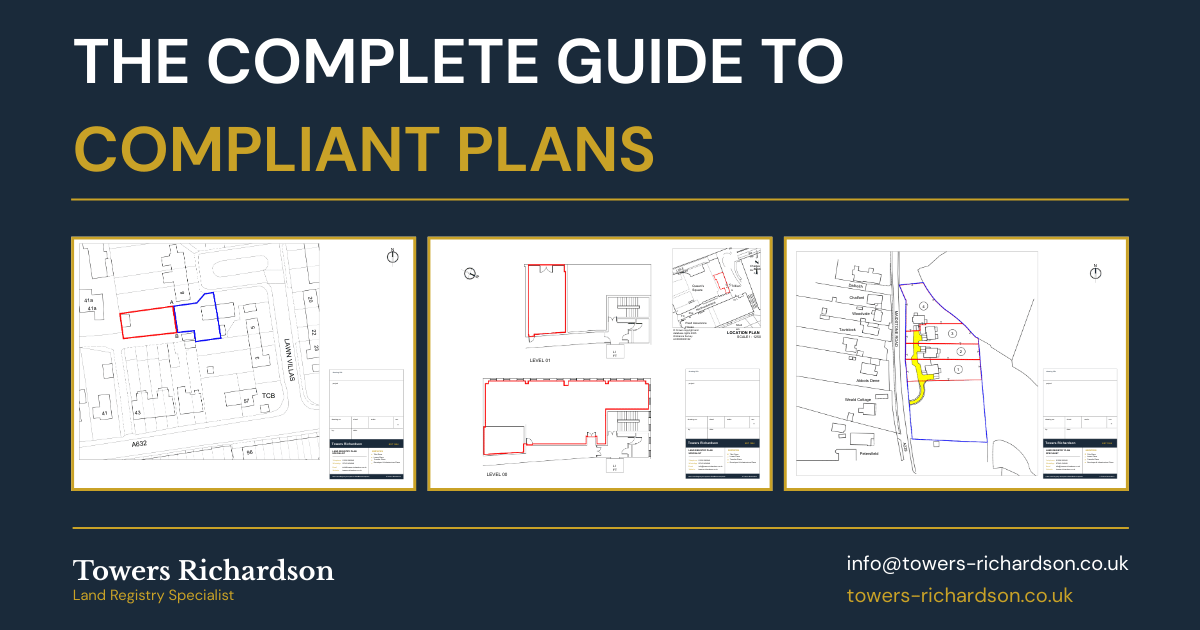
Shows the extent of a freehold property. Used for first registrations, sales of whole or part, and boundary corrections. Typically edged red on an OS base map.
Learn more about title plans →Lease Plan
Required for leases of 7 years or more. Includes a location plan and detailed floor plans showing the demised area, communal areas, and access routes.
Learn more about lease plans →Transfer Plan
Accompanies a TP1 transfer deed when part of a registered title is being sold or transferred. Must clearly distinguish the land being transferred from the retained land.
Learn more about transfer plans →Developer & Infrastructure Plans
Large-scale plans for housing estates, utility routes, and commercial developments. Often require multiple plot plans prepared to a consistent standard.
Learn more about developer plans →Land Registry Plan Requirements — Practice Guide 40
All plans submitted to HMLR must comply with the requirements set out in Practice Guide 40, Supplement 2. This is the official guidance document that sets the standard for plan preparation, and it is the benchmark against which every submission is assessed.
The key requirements are as follows:
1. Based on the Ordnance Survey Map
Every Land Registry plan must show sufficient Ordnance Survey (OS) detail — roads, buildings, field boundaries and other surrounding features — to allow HMLR to accurately locate the property on their own OS-based mapping. A plan drawn in isolation, without recognisable surrounding context, will not be accepted.
2. Drawn to a Stated, Metric Scale
Plans must be drawn to an appropriate metric scale. The scale used must be stated on the plan and must be accurate — meaning the measurements on the plan must correspond correctly to the stated scale. A scale bar should also be included.
3. Include a North Point
Every plan must include a north point to confirm its orientation. This allows HMLR to correctly position the plan in relation to the OS map.
4. Clear Boundary Edging
The property boundary must be shown by a continuous line of coloured edging. There must be no gaps in the boundary — it must form a complete, enclosed area. The edging must follow the inner edge of any boundary feature shown on the OS map.
5. Show Sufficient Surrounding Detail
The plan must include enough surrounding roads, buildings and landmarks outside the property boundary for HMLR to pinpoint the location. An isolated boundary with no context is one of the most common reasons for requisition.
6. Date of Preparation
The plan should include the date it was created, providing a record of when the mapping data was current.
7. No Prohibited Phrases
Certain wording must not appear on any plan submitted to HMLR. We cover these in detail below.
Practice Guide 40 Tip: HMLR’s full guidance runs to many pages and covers specialist situations including airspace, subsoil, and strata title registrations. For standard residential transactions, the requirements above cover the essentials — but for complex or unusual applications, it is worth reviewing the full guide or instructing a specialist.
Accepted Scales & Ordnance Survey Data
Choosing the correct scale is critical. The plan must be detailed enough for HMLR to identify the property clearly, but at a scale that is practical for the size of the land involved.
| Scale | Best Used For | Coverage |
|---|---|---|
| 1:200 or 1:500 | Individual flats, small commercial units, lease plans | High detail — individual rooms visible |
| 1:1250 | Urban and suburban residential properties | Standard for most house sales and transfers |
| 1:2500 | Rural land, farms, larger sites | Wider area — suitable for fields and estates |
| 1:10000 or smaller | Very large rural areas, infrastructure routes | Location context for extensive land holdings |
All plans must be based on current Ordnance Survey mapping data. OS data provides the authoritative base map that HMLR uses to verify property locations. Using outdated mapping — or hand-drawn sketches without an OS base — is a common cause of rejection.
At Towers Richardson, we hold a full Ordnance Survey licence and work directly with current OS MasterMap data in our CAD systems, ensuring every plan is plotted against the most up-to-date mapping available.
Colouring Conventions & Boundary Edging
While HMLR does not mandate specific colours, there are well-established conventions used across the profession that solicitors and Land Registry caseworkers expect to see:
- Red edging — shows the extent of the property being registered, transferred or leased
- Blue edging — identifies any retained land (the part being kept by the seller)
- Brown colouring — indicates a right of way or easement that benefits the property
- Green colouring — indicates common areas
- Additional colours — used to distinguish multiple parcels or different floor levels in lease plans
An important practical point: colours must remain clearly distinguishable when printed. Colours that look distinct on screen — such as orange and brown, or red and pink — can become difficult to differentiate on paper. This is a surprisingly common issue that we regularly see when reviewing plans prepared by others.
Need a Land Registry Plan?
Get a compliant plan prepared by specialists with a 100% HMLR acceptance rate. Most plans delivered within 24–48 hours.
Get a Free QuoteCommon Reasons Land Registry Plans Get Rejected
After 30 years of preparing plans, we have seen — and been asked to correct — virtually every type of plan rejection. These are the issues that cause the most problems:
- Insufficient surrounding detail — the plan only shows the property boundary with no roads, buildings or other features nearby, making it impossible for HMLR to locate the land on the OS map
- Not drawn to a stated scale — the plan has no scale bar, no scale statement, or the stated scale does not match the actual measurements
- Gaps in the boundary edging — the coloured boundary line does not form a complete, continuous enclosure
- Using an outdated or inaccurate base map — hand-drawn sketches, old estate agent plans, or plans based on superseded OS data
- Prohibited phrases on the plan — see the next section
- Colours that are indistinguishable when printed — particularly when multiple colours are used in close proximity
- No north point — a basic requirement that is sometimes overlooked
- Plan not consistent with the deed description — the verbal description in the deed does not match what is shown on the plan
- Poor print quality — faded or pixelated plans where boundary lines or OS detail cannot be clearly read
When a plan is rejected (formally called a “requisition”), HMLR will write to the applicant’s solicitor explaining what needs to be corrected. This creates a delay — typically several weeks at minimum — and may require a replacement plan to be prepared from scratch. Getting the plan right first time is always faster, cheaper and less stressful.
Prohibited Phrases & Marks
HMLR will not accept any plan that includes wording which casts doubt on the reliability or accuracy of the plan. The following phrases (and anything similar) must not appear on a plan submitted for registration:
- “For identification purposes only”
- “Do not scale from this drawing”
- “Not to scale”
- “For illustrative purposes only”
- “This plan is indicative only”
- “Subject to survey”
- “Draft” or “Preliminary”
- “Approximate boundary” or similar qualifications
These phrases are commonly found on estate agent plans, architect’s preliminary drawings and informal sketches. Any plan bearing such wording will need to be replaced with a clean, compliant version before HMLR will process the application.
From our experience: The most frequent issue we see is solicitors submitting estate agent floor plans or marketing brochure extracts that carry “for identification purposes only” or “not to scale” disclaimers. These will always be rejected. A purpose-prepared Land Registry plan is needed instead.
DIY vs Professional Land Registry Plans
It is technically possible to prepare your own Land Registry plan, provided it meets all of HMLR’s requirements. In practice, however, the majority of plans submitted by non-specialists contain errors that lead to requisitions.
The main challenges with a DIY approach are access to current Ordnance Survey data (which requires a commercial licence), the ability to plot accurately to stated scales, and understanding HMLR’s detailed requirements for different application types. For simple, straightforward properties, a competent person with the right data may be able to produce an acceptable plan — but for anything involving lease plans, partial transfers, or complex boundaries, professional preparation is strongly recommended.
A specialist Land Registry plan provider uses licensed OS data, professional CAD software, and an in-depth understanding of Practice Guide 40 to prepare plans that meet HMLR’s standards consistently. The cost of professional preparation is modest relative to the delays and legal costs that a rejected plan can cause.
What to Look for in a Plan Provider
When choosing who to prepare your Land Registry plan, consider the following: Do they specialise in Land Registry plans, or is it a sideline? Do they hold an Ordnance Survey licence? What is their turnaround time? Can they demonstrate a strong acceptance rate? And are they familiar with the specific requirements for your type of application?
At Towers Richardson, Land Registry plan preparation is all we do. It has been our sole focus since 1994, and that specialist expertise is reflected in our 100% acceptance rate and the trust placed in us by solicitors, developers and property professionals across England and Wales.
How Much Does a Land Registry Plan Cost?
The cost of a Land Registry plan depends on the type of plan required, the complexity of the property, and how quickly you need it. As a general guide:
A straightforward title plan or lease plan for a standard residential property starts from £115. Developer projects and large-scale infrastructure work are priced on a project basis.
If you do not have existing floor plans or drawings that can be used as a base for a lease plan, a measured survey of the premises will be required at additional cost. We will always confirm this upfront when quoting.
When comparing costs, remember that the cheapest option is not always the best value. A plan that gets rejected costs you the original fee plus the cost of a replacement, not to mention the delay to your transaction. Getting it right first time with a specialist provider is almost always the most cost-effective approach.
We provide fixed-price quotes with no hidden fees. Request a quote and we will confirm the cost before any work begins.
How Long Does It Take?
At Towers Richardson, we typically deliver completed plans within 24 to 48 hours of receiving your instructions. Urgent same-day turnarounds are available for time-critical transactions.
The main factors that affect timescales are the complexity of the plan, whether a site visit or measured survey is required, and the completeness of the information provided. For most standard title plans and transfer plans, we can work from the deed description, existing title plans and OS data without needing to visit the property.
Lease plans involving internal floor layouts may require a measured survey of the premises, which adds a small amount of time — but even with a survey, we aim to have completed plans back within a few working days.
30+ Years. 100% Acceptance Rate.
Trusted by solicitors, developers and property professionals across England and Wales since 1994.
Request Your Free QuoteFrequently Asked Questions
What is a Land Registry plan?
A Land Registry plan is a scaled drawing showing the boundaries and extent of a property or parcel of land. It is submitted to HM Land Registry as part of applications to register, transfer, or lease property. The plan must be based on the Ordnance Survey map and comply with the requirements set out in Practice Guide 40.
Do I need a Land Registry plan to sell my house?
If you are selling your entire property and it is already registered with a clear title plan, you may not need a new plan. However, if you are selling part of your land, or if the existing title plan is unclear or inaccurate, a new Land Registry-compliant plan will be required to accompany the transfer deed.
What scale should a Land Registry plan be?
The most commonly used scales are 1:1250 for urban and suburban properties and 1:2500 for rural land. Lease plans showing individual floor layouts are often drawn at 1:200 or 1:500. The scale must be stated on the plan and must be metrically accurate.
Can I draw my own Land Registry plan?
You can, provided it meets all of HMLR’s requirements — including being based on current OS data, drawn to a stated metric scale, with a north point and sufficient surrounding detail. In practice, most DIY plans contain errors that result in rejection. Using a specialist provider is recommended to avoid delays.
How much does a Land Registry plan cost?
Costs vary depending on the type and complexity of the plan. Title plans and lease plans start from £115. If a measured survey is needed for lease plans where no existing drawings are available, there is an additional cost. We provide fixed-price quotes upfront — contact us for a personalised quote.
How long does it take to get a Land Registry plan?
We typically deliver plans within 24 to 48 hours. Same-day urgent turnarounds are available when needed. Lease plans requiring a measured survey may take a few working days.
What is Practice Guide 40?
Practice Guide 40 (PG40) is HM Land Registry’s official guidance on the preparation of plans for registration applications. It sets out the technical requirements that all submitted plans must meet, including scale, orientation, boundary treatment, and prohibited phrases. Supplement 2 of PG40 contains the detailed specifications.
What is the difference between a title plan and a lease plan?
A title plan shows the extent of a freehold property and is used for registrations and transfers. A lease plan is specifically required when registering a lease of 7 years or more, and typically includes both a location plan (showing the property on the OS map) and detailed floor plans showing the extent of the demised premises.
Why was my Land Registry plan rejected?
The most common reasons for rejection include insufficient surrounding detail, missing north point or scale, gaps in the boundary edging, use of prohibited phrases such as “not to scale”, and plans based on outdated mapping. If your plan has been rejected, we can prepare a compliant replacement — often within 24 hours.
Need Help With Your Land Registry Plan?
Towers Richardson has been preparing Land Registry-compliant plans since 1994. Whether you need a simple title plan for a house sale, a detailed lease plan for a commercial property, or a suite of plans for a major development, we can help.
Every plan is prepared using licensed Ordnance Survey data, professional CAD software, and checked against Practice Guide 40 requirements before delivery. We work with solicitors, estate agents, property developers, housing associations and homeowners across England and Wales.
Get in touch today:
📧 info@towers-richardson.co.uk
📞 01226 885040
💬 WhatsApp: 07543 434048
Or request a free quote online — we respond within 1 hour during business hours.