Last updated: February 2026 — using HMLR data from November 2025
One of the most common questions we hear from solicitors, conveyancers and homeowners alike is: how long does the Land Registry take?
The honest answer is that it depends — on the type of application, the complexity of your transaction, and how accurately the paperwork has been prepared. Some applications are processed within minutes. Others can take well over a year.
In this guide, we break down the current HM Land Registry processing times for every major application type, explain what causes delays, and share practical steps you can take to avoid them. All figures are based on official HMLR data.
The key thing to know: Your legal rights are protected from the moment HMLR receives your application — not when they finish processing it. Even if it takes months to complete, your transaction is secured from day one.
Current Processing Times at a Glance
HM Land Registry processes approximately 2.5 million applications per month. The vast majority — around 83.5% — are completed within a single day. These are mostly automated information requests such as official searches and official copies.
The applications that take longer are those that require a caseworker to review them manually. These include property transfers, first registrations, new leases and transfers of part.
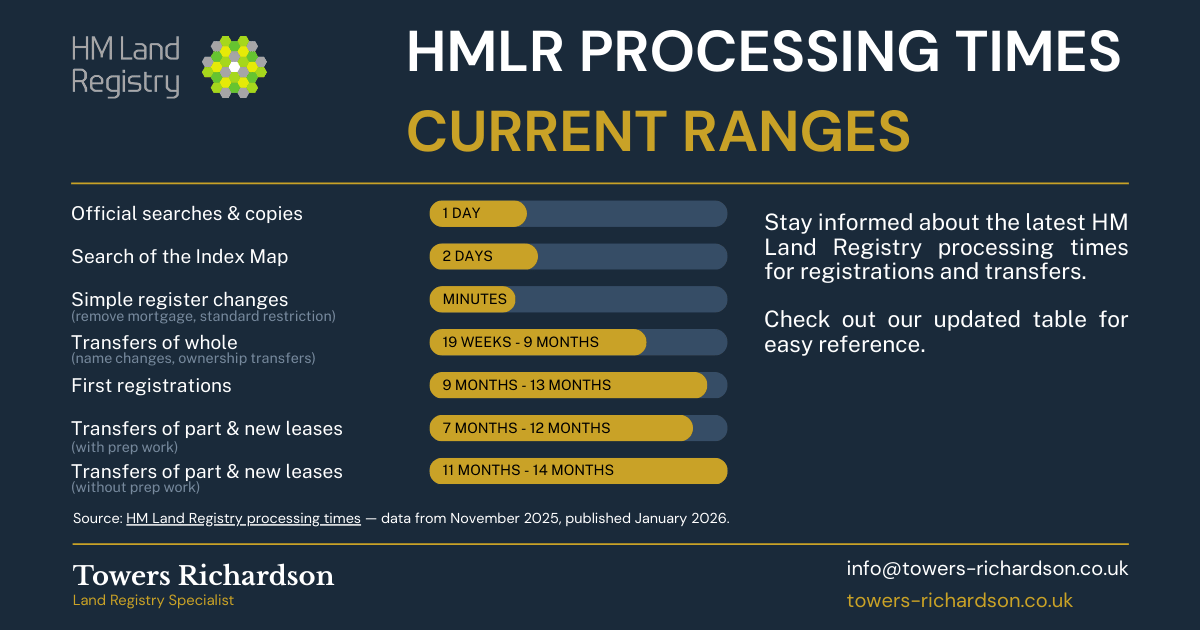
Here is a summary of current processing times based on HMLR’s most recent published data:
| Application Type | 50% Completed In | Most Completed In |
|---|---|---|
| Official searches & copies | 1 day | 1–3 days |
| Search of the Index Map | 2 days | 2–3 days |
| Simple register changes (remove mortgage, standard restriction) | Minutes | Automated — same day |
| Transfers of whole (name changes, ownership transfers) | ~19 weeks | ~9 months |
| First registrations | ~9 months | ~13 months |
| Transfers of part & new leases (with prep work) | ~7 months | ~12 months |
| Transfers of part & new leases (without prep work) | ~11 months | ~14 months |
Source: HM Land Registry processing times — data from November 2025, published January 2026.
As you can see, the difference between a straightforward search and a complex registration can be enormous. Let’s look at each category in more detail.
Information Services & Searches (1–3 Days)
The fastest Land Registry services are the information requests — official searches, official copies of the title register and title plan, and searches of the index map. These are the services your solicitor or conveyancer uses to check ownership details before a transaction goes ahead.
HMLR processes approximately 2.1 million of these requests every month, and the vast majority are handled very quickly:
- 93.4% of information requests are completed within 1 day
- 97.6% are completed within 2 days
- 99.7% are completed within 3 days
- Only 0.3% take longer than 3 days
If a search needs to be handled manually — for example, a search of the index map where the property boundary needs to be verified — it may take 2 to 3 days rather than being processed instantly. But overall, information services are the one area where HMLR’s performance is consistently fast.
What this means for your transaction: Conveyancing searches should not hold up your purchase or sale. If your solicitor tells you they are waiting on Land Registry search results, it should only be a matter of days — not weeks.
Transfers & Register Updates (1 Day – 11 Months)
Once a property sale completes and stamp duty has been paid, the solicitor submits an application to HMLR to update the register with the new owner’s details, mortgage information, and any other changes. This is where processing times start to vary significantly.
HMLR handles approximately 413,000 register update applications per month. The breakdown looks like this:
| Timescale | Percentage Completed |
|---|---|
| Within 1 day | 41.3% |
| Within 1 week | 9.2% |
| Within 1 month | 4.0% |
| Within 3 months | 9.3% |
| Longer than 3 months | 36.2% |
The good news is that just over 41% of register updates are now automated and completed within minutes. These are typically straightforward applications like removing a discharged mortgage or registering a standard form of restriction — applications where the data can be validated electronically without a caseworker needing to check it.
The less encouraging picture is for the remaining applications that require manual processing. If your transfer of ownership needs a caseworker to review it, HMLR’s current data shows:
- 50% completed in about 19 weeks (roughly 4½ months)
- Most completed in about 9 months
- Some taking up to 11 months
These figures apply to transfers of whole title — meaning you are selling or buying an entire property, not just part of it. If you are selling part of your land (a transfer of part), the timescales are even longer — see the next section.
Important reminder: Even though registration may take months to complete, your ownership is legally protected from the moment HMLR receives the application. You do not need to wait for registration to complete before moving in, taking out a mortgage, or treating the property as yours.
First Registrations, Leases & Transfers of Part (7–14 Months)
The longest processing times are for complex applications — first registrations of unregistered land, new leases, transfers of part, and multi-title developer applications. HMLR processes approximately 35,000 of these per month, and the timescales are significantly longer than standard transfers.
First Registrations
If you are registering land or property with HMLR for the first time — for example, following the sale of a property that has never been registered — expect the following timescales:
- 50% completed in about 9 months
- Most completed in about 13 months
- A small number may take a few weeks longer depending on complexity
First registrations are inherently more complex because HMLR has to create a new title from scratch. They need to examine the original deeds, verify the applicant’s ownership chain, reconcile old deed plan boundaries with current Ordnance Survey mapping, and create a brand new title plan. If the deeds are old, unclear or incomplete, this adds further time.
Transfers of Part & New Leases
Applications to divide an existing title (transfer of part) or register a new lease (dispositionary first lease) are also among the slowest to process. Processing times depend heavily on whether preparatory work has been done with HMLR in advance:
| Scenario | 50% Completed In | Most Completed In |
|---|---|---|
| With preparatory work | ~7 months | ~12 months |
| Without preparatory work | ~11 months | ~14 months |
The difference between these two scenarios is significant — 4 months faster when preparatory work has been done. This is particularly relevant for property developers submitting multiple plot sales. Working with HMLR to agree boundaries and plan requirements before the first sale goes through can dramatically reduce processing times for every subsequent plot.
A Major Factor: Requisitions
One of the most striking statistics from HMLR’s data is that between 55% and 65% of complex applications contain errors or omissions that require HMLR to go back to the applicant for clarification. Each time this happens, the application goes to the back of the queue while the caseworker waits for a response — potentially adding weeks or months to the total processing time.
This is a factor that is within your control. We cover this in detail in the sections below.
Don’t Let Your Plan Cause a Delay
We prepare HMLR-compliant plans with a 100% acceptance rate. Most plans delivered within 24 hours.
Get a Free QuoteWhy Is the Land Registry So Slow?
If you have been waiting months for a Land Registry application to complete, you are not alone — and the reasons for the current processing times are well documented:
Post-Pandemic Backlog
The Stamp Duty Land Tax holiday introduced during the COVID-19 pandemic triggered an enormous surge in property transactions. HMLR was already under pressure before the pandemic, and the resulting wave of applications created a backlog that has taken years to work through. Although the holiday ended in 2021, the knock-on effects on processing times are still being felt.
Staffing and Capacity
HMLR has increased its caseworker workforce by around 1,000 people in recent years, including over 500 in the last two years alone. However, training new caseworkers takes time, and the complexity of many applications means that experience matters. The expanded workforce is helping, but the impact on processing times has been gradual rather than immediate.
High Requisition Rates
As noted above, the majority of complex applications contain errors that require HMLR to send a requisition — a request for clarification or additional information. Every requisition pauses the application and adds to the overall workload. Reducing the number of avoidable requisitions would make a significant difference to processing times across the board.
Digital Transformation
HMLR is investing in automation and digital submission to speed up processing. Around 30% of register update applications are already automated and completed within minutes. The Digital Registration Service and Business Gateway APIs are handling hundreds of thousands of applications, with further improvements planned through 2026 and beyond. But automating complex, caseworker-reviewed applications is a longer-term project.
Requisitions — The Biggest Cause of Avoidable Delay
A requisition is when HMLR writes to the applicant’s solicitor to request corrections or additional information before the application can be processed. It is the single biggest cause of avoidable delay.
According to HMLR’s own data, 55% to 65% of complex applications are raised as requisitions. That means the majority of first registrations, new leases and transfers of part get sent back at least once before they can be completed.
Common reasons for requisitions include:
- Plan deficiencies — the submitted plan does not meet Practice Guide 40 requirements (missing north point, no scale bar, prohibited phrases, insufficient surrounding detail)
- Missing documents — required supporting documents not included with the application
- Form errors — incorrect or incomplete application forms
- Description mismatch — the verbal description in the deed does not match what is shown on the plan
- Boundary ambiguity — HMLR cannot determine the intended boundary from the plan and deed combined
- Fee issues — incorrect fee paid for the application type
Every requisition that could have been avoided represents weeks — sometimes months — of unnecessary delay. The plan is one of the most common sources of requisitions, and it is one of the easiest to get right by using a specialist provider.
How to Avoid Delays to Your Application
While you cannot control HMLR’s backlog or staffing levels, there are practical steps you can take to give your application the best chance of being processed without unnecessary hold-ups:
- Use a compliant plan from the outset — ensure your Land Registry plan meets all Practice Guide 40 requirements before submission. A non-compliant plan is one of the most common reasons for requisition.
- Check all forms thoroughly — make sure application forms (AP1, FR1, TP1, etc.) are completed correctly with no missing fields or signatures
- Include all required documents — title deeds, certified copies, consents, certificates — check the application requirements for your specific transaction type
- Ensure deed and plan match — the verbal description in the deed must correspond accurately with what is shown on the plan
- Submit digitally where possible — applications submitted through the HMLR portal or Business Gateway are processed faster than paper applications
- Use preparatory services for developments — if you are a developer, engaging HMLR early to agree boundaries and requirements can save months on every subsequent plot sale
- Respond to requisitions promptly — if HMLR does raise a requisition, respond as quickly as possible with all the information requested. Delayed responses extend processing times further.
- Pay the correct fee — fee calculators are available on GOV.UK to ensure you submit the right amount
Our experience: The applications we see going through fastest are those where the plan is fully PG40-compliant, the forms are correct, and all documents are included from the start. Getting everything right upfront removes the single most common cause of delay — the requisition.
How to Expedite a Land Registry Application
If a delay to your application would cause significant problems or put a property transaction at risk, you can ask HMLR to expedite (fast-track) your application. This is a free service — there is no charge for requesting it.
HMLR helped over 200,000 applicants through the expedite service in the past year, and the vast majority of expedited applications are processed within 10 working days.
When Can You Request an Expedite?
You can request an expedite when a delay would:
- Put a property sale or transaction at risk — for example, a chain is about to collapse or a mortgage offer is expiring
- Cause financial hardship or serious problems — for example, a refinancing deal depends on the registration being completed
- Affect a development timetable — where registration is needed before construction or further sales can proceed
You will need to provide evidence to support your request — such as a memorandum of sale, exchange of contracts, or a mortgage offer with an expiry date.
How to Request an Expedite
You (or your solicitor) can request an expedite by:
- Online: Send a message through the HMLR contact form
- Phone: Call HMLR on 0300 006 0411
Include your application reference number, the title number (if applicable), and a clear explanation of why the delay is causing problems, supported by evidence.
Don’t Let Your Plan Be the Reason for Delay
Of all the factors that cause requisitions, the plan is one of the most frequently cited — and one of the most avoidable. A plan that does not comply with Practice Guide 40 will be sent back, adding months to an already lengthy process.
The most common plan-related issues that trigger requisitions are:
- Prohibited phrases on the plan — such as “for identification purposes only” or “not to scale”
- No stated scale or scale bar
- Missing north point
- Insufficient surrounding detail — HMLR cannot locate the property on the Ordnance Survey map
- Gaps in the boundary edging — the coloured line does not form a complete enclosure
- Based on outdated mapping — not using current Ordnance Survey data
- Using estate agent plans — marketing floor plans are not suitable for Land Registry submissions
At Towers Richardson, every plan we prepare is checked against Practice Guide 40, Supplement 2 before delivery. We use licensed, current Ordnance Survey data, draw to stated metric scales, and ensure full compliance with HMLR’s requirements. Our 100% acceptance rate since 1994 means one less thing that can go wrong with your application.
Plans start from £115, and most are delivered within 24 hours. When your application could be sitting in a queue for months, there is no reason to risk an additional delay because of the plan.
Plans from £115. Delivered in 24 Hours.
100% HMLR acceptance rate since 1994. Trusted by solicitors, developers and property professionals across England & Wales.
Get Your Free QuoteFrequently Asked Questions
How long does Land Registry take to transfer ownership?
For a straightforward transfer of whole title (buying or selling an entire property), HMLR currently completes 50% of applications in about 19 weeks. Most are completed in about 9 months, with some taking up to 11 months. Simple register changes like removing a mortgage are automated and completed the same day.
How long does a first registration take?
First registrations of previously unregistered land currently take about 9 months for 50% of applications, with most completed in about 13 months. These take longer because HMLR has to examine the original deeds and create a completely new title from scratch.
How long does it take to register a new lease?
New lease registrations currently take about 7 months (50% of applications) where preparatory work has been done, or about 11 months where it has not. Most are completed within 12 to 14 months.
How long does a Land Registry search take?
Official searches and official copies are very fast — 93.4% are completed within 1 day, and 99.7% within 3 days. A search of the index map may take 2 to 3 days if it needs to be processed manually.
Can I speed up a Land Registry application?
Yes. If a delay would cause significant problems or put a transaction at risk, you can request a free expedite from HMLR. Most expedited applications are processed within 10 working days. You can also reduce the risk of delay by ensuring your plan, forms and documents are all correct before submission.
Why is Land Registry taking so long?
The main factors are the post-pandemic application backlog, the time needed to train new caseworkers, and the high rate of requisitions (55–65% of complex applications contain errors). HMLR is investing in automation and digital services to improve processing times, but progress has been gradual.
What is a requisition?
A requisition is when HMLR writes to the applicant’s solicitor asking for corrections or additional information. It pauses the application until the requested information is provided. Common causes include non-compliant plans, form errors, and missing documents.
Is my property safe while waiting for Land Registry?
Yes. Your legal rights are protected from the moment HMLR receives the application. Even if processing takes months, no other application lodged after yours can take priority over it. This is known as “priority protection.”
How do I check the status of my Land Registry application?
Your solicitor can check the status through the HMLR portal. HMLR also publishes estimated completion timeframes at gov.uk, which are updated monthly and give a forward-looking estimate of when your specific application type is likely to be completed.
Can a non-compliant plan delay my application?
Absolutely. Plan deficiencies are one of the most common causes of requisition. If your plan does not meet Practice Guide 40 requirements, HMLR will raise a requisition and your application will be paused until a compliant replacement is submitted. Using a specialist plan provider avoids this entirely.
Need a Land Registry Plan?
With processing times stretching to 9 months or more for many application types, the last thing you want is an avoidable delay caused by a non-compliant plan. At Towers Richardson, we have been preparing Land Registry plans since 1994 — and we have maintained a 100% HMLR acceptance rate throughout.
Every plan is prepared using licensed Ordnance Survey data, professional CAD software, and checked against Practice Guide 40 requirements before delivery. We work with solicitors, estate agents, property developers, housing associations and homeowners across England and Wales.
Get in touch today:
📧 info@towers-richardson.co.uk
📞 01226 885040
💬 WhatsApp: 07543 434048
Or request a free quote online — we respond within 1 hour during business hours.
