Boundary ownership is one of the most misunderstood topics in property law. Many people believe there are firm rules about who owns which fence or wall — for example, the widespread belief that fence posts and arris rails always face the owner’s side. In reality, there is no legal foundation for most of these assumptions.
In this guide, we explain how boundary ownership actually works, what the Land Registry title plan does and does not tell you, how T marks on deeds and title plans indicate maintenance responsibility, and what to do when boundary ownership is unclear. We also cover the common myths that cause confusion and the practical steps you can take to clarify your position.
Important: HM Land Registry does not guarantee the exact position of property boundaries. The title plan shows the general boundary only. If you need to establish precise boundary ownership or resolve a dispute, specialist advice is recommended. Towers Richardson prepares accurate plans that support boundary documentation — contact us if you need help.
How Boundary Ownership Works
Boundary ownership refers to which property owner is responsible for a boundary feature — a fence, wall, hedge or other structure that marks the dividing line between two properties. In England and Wales, there is no automatic legal rule that determines who owns a particular boundary. Instead, ownership depends on what the deeds say.
When a property is first developed and the land is divided into individual plots, the developer’s transfer deeds typically contain clauses and plan markings that allocate boundary responsibility. These provisions are then carried forward each time the property changes hands. If the original deeds are clear, the position should be straightforward. The problem is that many properties — particularly older ones — have no clear provision about boundary ownership at all.
The Land Registry register will only record information about boundary ownership when it is specifically referred to in the deeds lodged for registration. If the deeds are silent on the matter, the register will be too.
Common Myths About Boundary Ownership
There are several widely held beliefs about boundary ownership that have no basis in law. These myths cause more confusion and neighbour disputes than almost any other property issue.
- “The fence posts face the owner’s side” — this is the most common myth. There is no legal rule that says the posts and arris rails of a fence indicate ownership. While some developers do follow this convention when erecting fences on new estates, it is not a legal requirement and cannot be relied upon
- “You always own the left-hand boundary” — another persistent myth with no legal foundation. There is no standard rule that allocates the left or right boundary to either property when viewed from the road
- “The boundary is always in the middle of the fence” — this is sometimes true but cannot be assumed. The boundary may run along one side of the fence, through the middle, or even some distance from it
- “If I maintain a fence, I own it” — maintaining a boundary feature does not automatically confer ownership. Many people voluntarily maintain fences for appearance or security without being legally responsible for them
- “A covenant to maintain means I own the boundary” — a deed may contain a covenant requiring you to maintain a wall or fence, but this is a maintenance obligation, not proof of ownership. The boundary structure may still be jointly owned
The reality: Boundary ownership can only be determined by looking at the deeds, the title plan, and any T marks or covenants that have been recorded. Physical features like fence posts and hedge growth do not provide reliable evidence of ownership in law.
What Are T Marks?
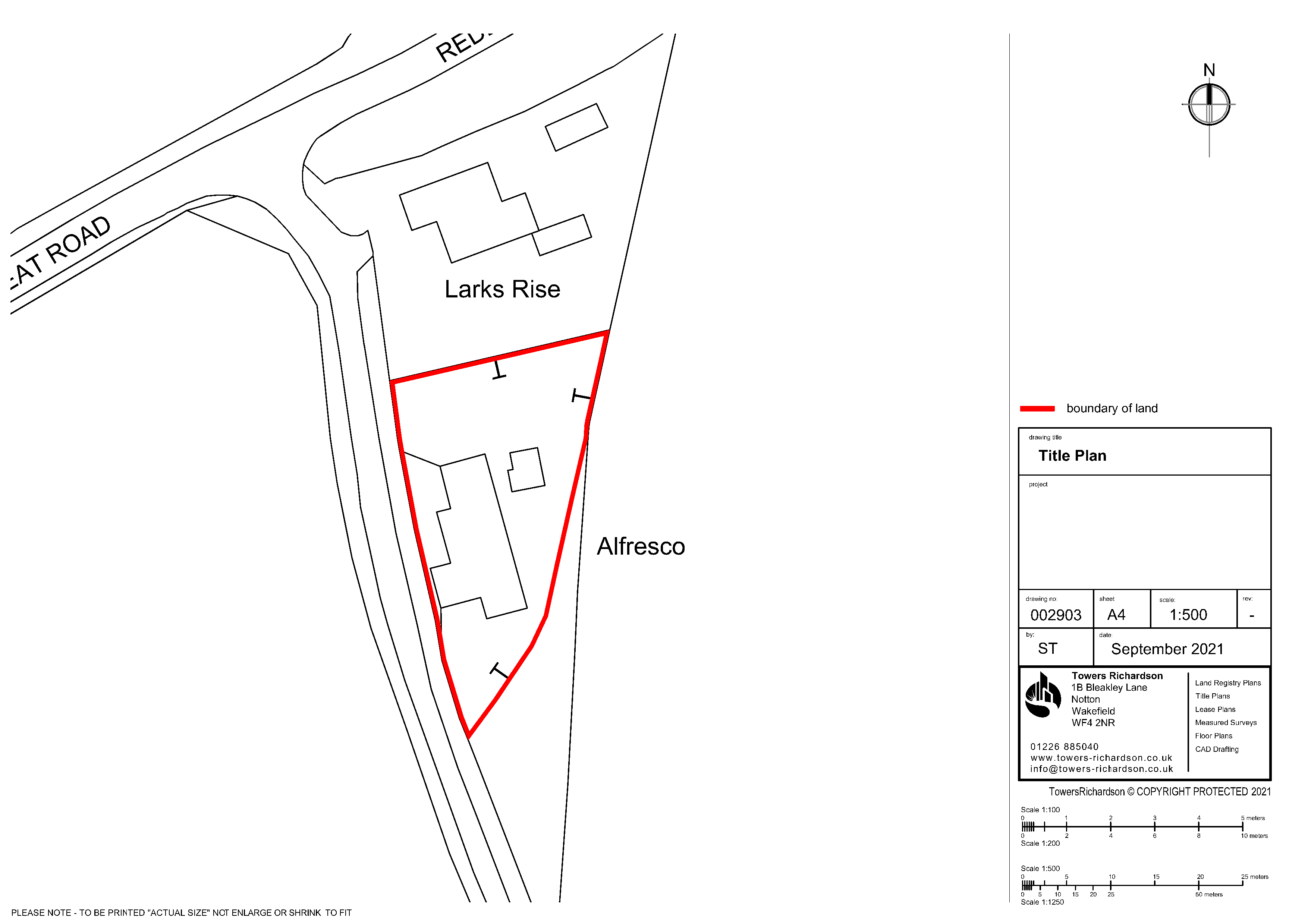
T marks are one of the most important boundary ownership indicators you will find on property deeds and title plans. A T mark is a small letter “T” drawn on the plan alongside a boundary line. The stem of the T points towards the property whose owner is responsible for that boundary feature.
For example, if a T mark on the boundary between your property and your neighbour’s is drawn with the stem pointing into your land, this typically means that you are responsible for maintaining the wall, fence or other boundary structure on that side.
When T marks appear on both sides of a boundary — forming an “H” shape — this indicates that both property owners share responsibility for the boundary feature. This is sometimes referred to as a “double T” or “H mark.”
What T Marks Mean in Practice
- Single T mark pointing into your land — you are responsible for maintaining that boundary fence, wall or hedge
- Single T mark pointing into your neighbour’s land — your neighbour is responsible for that boundary
- Double T marks (H mark) — both owners share responsibility for the boundary feature
- No T marks — the deeds do not specify who is responsible, and ownership cannot be determined from the title plan alone
It is worth noting that T marks on a deed plan primarily indicate maintenance responsibility rather than outright ownership. The distinction matters — a covenant to maintain a fence does not necessarily mean you own the land on which it stands. However, in practice, T marks are the closest indicator most property owners have to determining boundary responsibility.
How T Marks Work on Title Plans
HM Land Registry will reproduce T marks on the title plan when certain conditions are met. Understanding how this process works helps explain why some title plans show T marks and others do not.
When deeds are lodged for registration, HMLR examines the plans and the text of the deed. If the T marks on the deed plan are expressly referred to in the wording of the deed, HMLR will either reproduce them on the title plan with a corresponding register entry, describe the affected boundaries verbally in the register, or make a note that a copy of the deed plan showing the T marks is on file.
The register entry might read something like: “The T mark referred to in clause 4 affects the north-western boundary of the land in this title.” This tells you which boundary the T mark relates to, even if the mark itself is difficult to read on the title plan.
Need Help With a Boundary Plan?
We prepare accurate title plans and transfer plans that clearly show boundary features, T marks and ownership responsibilities. 100% HMLR acceptance rate.
Get a Free QuoteWhen T Marks Are Shown on the Title Plan
T marks are not automatically shown on every title plan. HMLR will only include them when they are both present on the deed plan and referred to in the text of the deed. Here is how the different scenarios play out.
T Marks Are Shown
If the T marks on the deed plan are expressly mentioned in the deed wording — for example, “the transferee shall maintain and keep in repair the boundary fence on the southern side of the property indicated by the T mark on the plan” — then HMLR will reproduce the T marks on the title plan and record the obligation in the register.
T Marks Are Not Shown
If the deed plan contains T marks but the text of the deed does not refer to them, the T marks have no special legal force. In this situation, unless the applicant specifically requests that the T marks be shown, HMLR will normally ignore them. This means many title plans do not show T marks even though the original deed plan included them.
T Marks Requested by the Applicant
An applicant can specifically request that HMLR reproduce T marks on the title plan, even if they are not referred to in the deed text. However, HMLR will only do this if the marks are clearly shown on the deed plan and the applicant makes the request at the time of registration.
What If There Are No T Marks?
Many properties — particularly older ones — have no T marks on their deeds or title plans at all. This does not necessarily mean that boundary ownership is unknown. It may simply mean that the original developer or conveyancer did not include them when the land was first sold.
When there are no T marks and the deeds do not specify boundary ownership, you may need to look at other evidence to determine who is responsible. This can include the physical characteristics of the boundary (though these are not conclusive), any informal agreements between neighbours, historical maintenance patterns, and the layout of surrounding properties from the same development.
In the absence of clear evidence, the boundary feature is generally best treated as a party boundary — shared between both adjoining owners.
Boundary Maintenance Responsibilities
Boundary ownership and maintenance responsibility are related but not identical concepts. Even where boundary ownership is established, the rules around maintenance can be surprising.
Is There a Legal Obligation to Maintain a Boundary?
In general, there is no automatic legal obligation to maintain a boundary fence or wall in England and Wales. Unless there is a specific covenant in the deeds requiring you to maintain the boundary, you are not legally compelled to keep it in repair — even if you own it.
However, there are important exceptions. If the deeds contain a covenant to maintain a boundary (indicated by T marks or stated in the text), that obligation is binding. In some cases, local planning conditions or conservation area rules may also require boundary features to be maintained. Where a boundary wall is a retaining wall that supports the neighbouring land, there may be an obligation to keep it in a safe condition.
What If Your Neighbour’s Boundary Fence Falls Down?
If your neighbour is responsible for a boundary fence and it falls into disrepair, you generally cannot compel them to fix it unless there is a covenant in their deeds requiring maintenance. You can, however, erect your own fence on your side of the boundary. Any alterations or replacement of a shared boundary feature should only be done with the agreement of both adjoining owners.
Party Boundaries
When boundary ownership cannot be determined from the deeds or title plan, the boundary feature is generally treated as a party boundary. This means it is considered to be shared between both adjoining property owners.
Party boundaries are common on older properties where the original conveyancing documentation did not address boundary responsibility. In practice, a party boundary means that neither owner has an exclusive right to alter, remove or replace the boundary feature without the agreement of the other.
If you want to make changes to a party boundary — for example, replacing a fence or lowering a wall — you should discuss this with your neighbour and agree the works in advance. Unilateral changes to a shared boundary can lead to disputes that are difficult and expensive to resolve.
How to Check Boundary Ownership
If you want to establish who owns a particular boundary, here are the steps to follow.
- Check your title plan — order a copy from HM Land Registry (available from GOV.UK for a small fee) and look for T marks along the boundaries
- Read the register entries — the property register and charges register may contain verbal references to boundary obligations that are not shown as T marks on the plan
- Review the original deeds — the transfer deed or conveyance that first created the boundary may contain clauses and plan markings about boundary responsibility. Your solicitor or mortgage lender may hold copies
- Check the neighbour’s title — sometimes the boundary obligation is recorded on the neighbouring title rather than your own. You can order their title documents from HMLR
- Look at the filed deed plan — HMLR sometimes holds a copy of the original deed plan on file, which may show T marks that were not reproduced on the title plan. You can request this from HMLR
If none of these sources provide a clear answer, the boundary is likely a party boundary and should be treated as shared.
What to Do About Boundary Disputes
Boundary disputes are among the most common — and most costly — property disagreements. If you are in a dispute about boundary ownership with a neighbour, the following steps are generally advisable.
- Start with the evidence — gather your title plan, register entries, original deeds and any historical photographs or documents that show the boundary position over time
- Talk to your neighbour — many boundary disputes can be resolved through direct, reasonable conversation before legal costs are incurred
- Seek professional advice — a solicitor specialising in property disputes can advise on your legal position based on the documentary evidence
- Consider mediation — boundary mediation is often faster and cheaper than going to court, and many disputes are successfully resolved this way
- Get an accurate plan — if the dispute centres on the position of the boundary, a professionally prepared plan showing the title boundary against the physical features on the ground can help clarify the situation
- Determined boundary application — in serious cases, you can apply to HMLR under Section 60 of the Land Registration Act 2002 to have the exact boundary determined and recorded. This requires a detailed plan prepared to specific standards
Practical advice: Boundary disputes can be disproportionately expensive relative to the value of the land in question. Before escalating, always check whether the documentary evidence (deeds, title plans, T marks) provides a clear answer. Many disputes arise from misunderstanding rather than genuine conflict about the legal position.
How Towers Richardson Can Help
At Towers Richardson, we prepare accurate Land Registry plans that help clarify boundary ownership and support property transactions. While we are not solicitors and do not provide legal advice on boundary disputes, we produce the plans that solicitors and property owners need to document boundary positions, T marks and maintenance responsibilities.
- Title plans — showing the registered boundaries of your property based on licensed OS data
- Transfer plans — for sales of part, with clear boundary edging and T marks where required
- Plans for determined boundary applications — prepared to the specific standards required by HMLR for Section 60 applications
- 100% HMLR acceptance rate — every plan is checked against Practice Guide 40 before delivery
- 30+ years of specialist experience — preparing Land Registry plans since 1994
- Fast turnaround — most plans delivered within 24 to 48 hours, with same-day options available
- Nationwide coverage — we serve clients across England and Wales
- Fixed-price quotes from £115 — no hidden fees, costs confirmed before work starts
30+ Years. 100% Acceptance Rate.
Trusted by solicitors, developers and property professionals across England and Wales since 1994.
Request Your Free QuoteFrequently Asked Questions
How do I find out who owns a boundary fence?
Check your title plan and register entries for T marks or verbal references to boundary responsibility. You can also review the original transfer deed, check the neighbour’s title, or request the filed deed plan from HM Land Registry. If none of these provide a clear answer, the boundary is likely shared between both properties.
What are T marks on a title plan?
T marks are small letter “T” symbols drawn alongside a boundary line on a deed plan or title plan. The stem of the T points towards the property whose owner is responsible for maintaining that boundary feature. Double T marks (forming an H) indicate shared responsibility between both adjoining owners.
Do fence posts always face the owner’s side?
No. This is a common myth with no legal foundation. While some developers follow this convention, it is not a legal rule and cannot be relied upon to determine boundary ownership. Only the deeds and title plan can provide reliable evidence of who is responsible for a boundary.
Am I legally required to maintain my boundary fence?
Not automatically. In England and Wales, there is no general legal obligation to maintain a boundary fence or wall unless a specific covenant in the deeds requires it. However, there may be obligations under local planning conditions, conservation area rules, or where a boundary wall serves as a retaining structure.
What is a party boundary?
A party boundary is one that is shared between two adjoining property owners. When boundary ownership cannot be determined from the deeds or title plan, the boundary feature is generally treated as a party boundary. Neither owner has an exclusive right to alter or remove it without the other’s agreement.
Why are there no T marks on my title plan?
T marks are only shown on the title plan when they appear on the deed plan and are expressly referred to in the deed text. If the original deed did not include T marks, or included them without mentioning them in the wording, they will not appear on the title plan. This does not necessarily mean that boundary ownership is unresolved — the deeds may address it in other ways.
Can I add T marks to my title plan?
T marks can only be added to the title plan if they are supported by the deeds. You cannot simply request HMLR to add T marks without documentary evidence. If you and your neighbour agree on boundary responsibility, a solicitor can prepare a deed that records the arrangement and includes T marks, which can then be registered.
What is a determined boundary?
A determined boundary is the exact legal boundary of a property, as opposed to the general boundary shown on most title plans. You can apply to HMLR under Section 60 of the Land Registration Act 2002 to have a boundary determined. This requires a detailed plan prepared to specific standards and is typically used to resolve serious boundary disputes.
Need a Plan for a Boundary Matter?
Towers Richardson has been preparing Land Registry-compliant plans since 1994. Whether you need a title plan showing your registered boundaries, a transfer plan with T marks for a property sale, or a plan for a determined boundary application, we can help.
We work with solicitors, homeowners, developers and property professionals across England and Wales.
Get in touch today:
📧 info@towers-richardson.co.uk
📞 01226 885040
💬 WhatsApp: 07543 434048
Or request a free quote online — we respond within 1 hour during business hours.