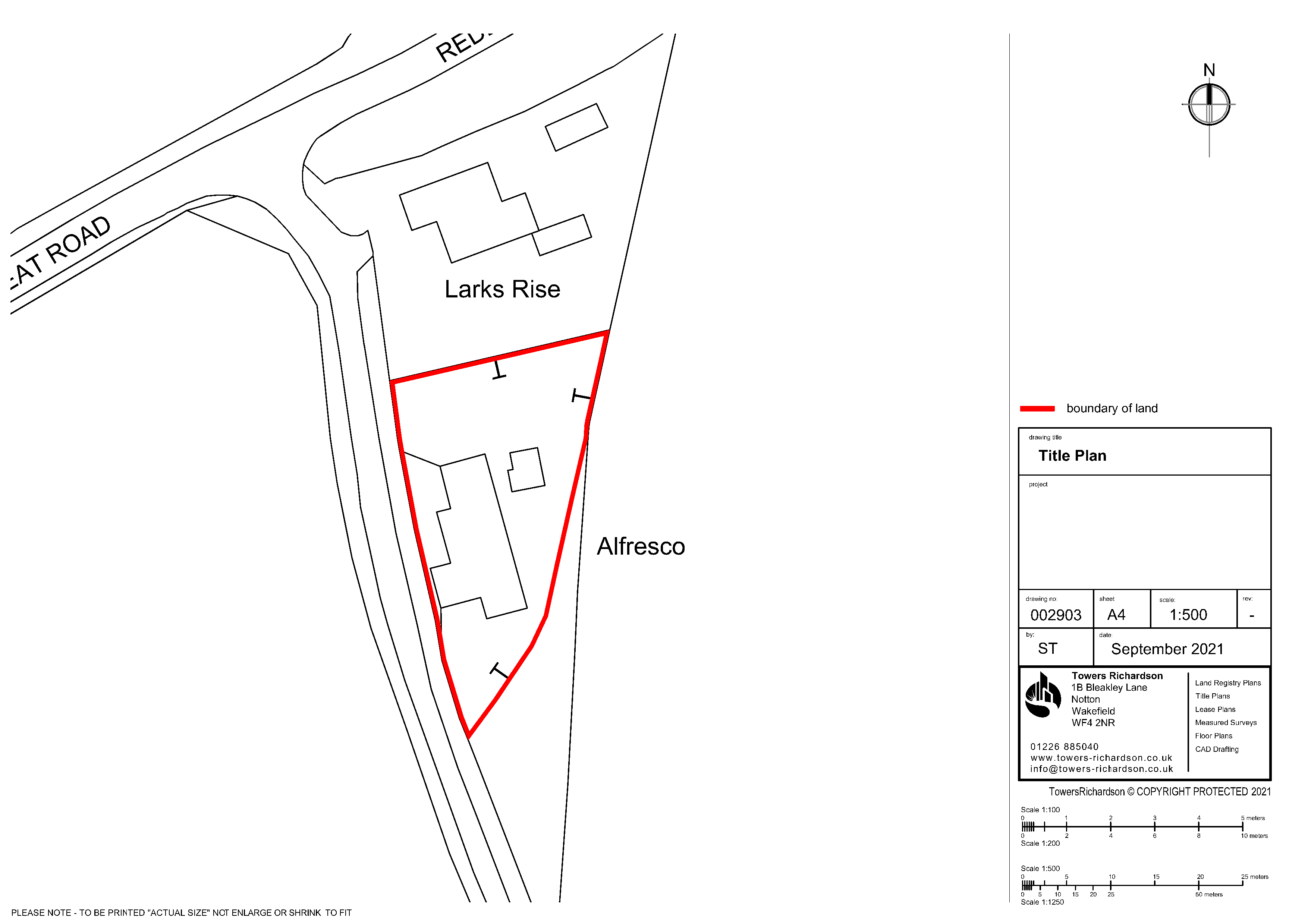
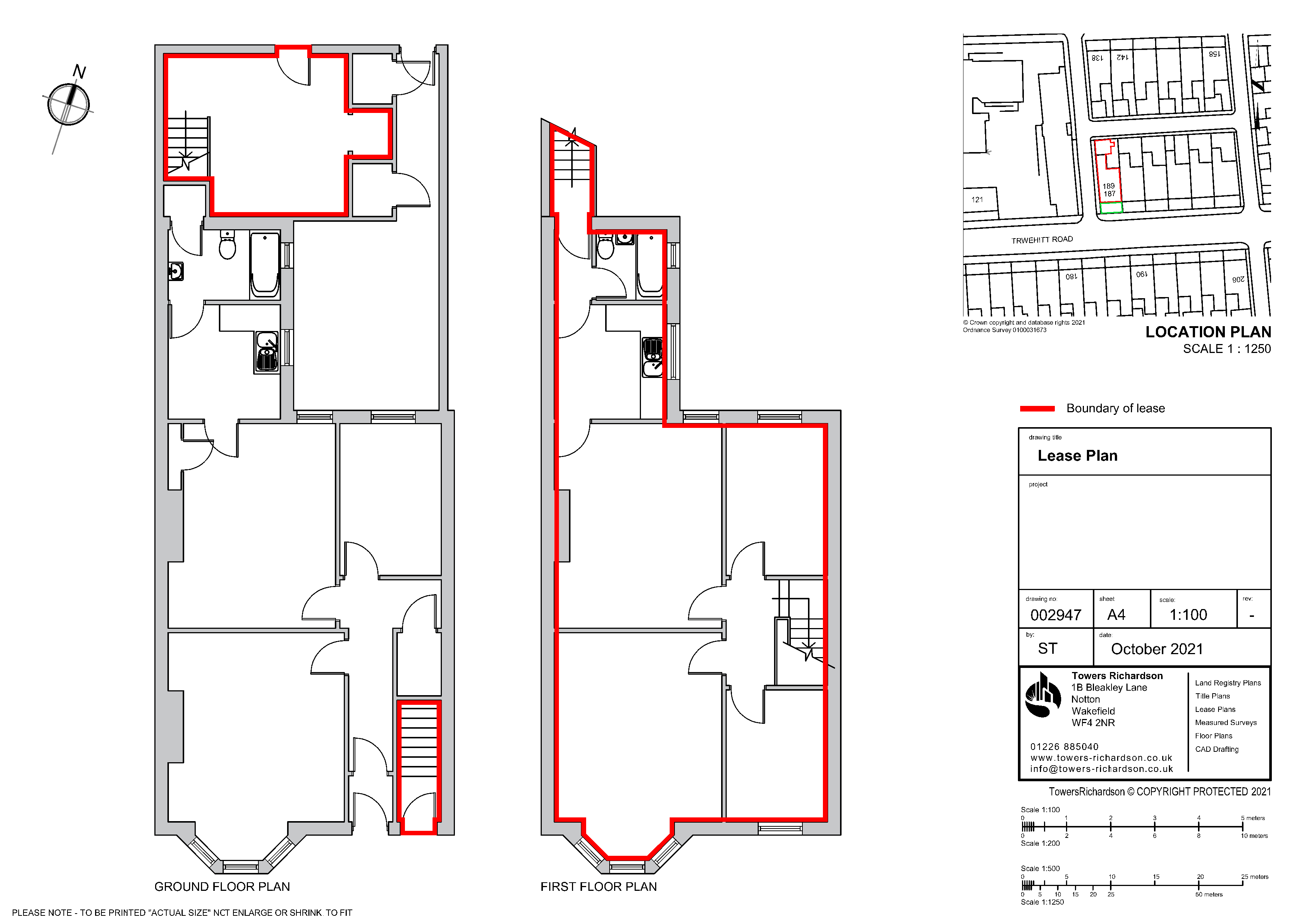
T marks indicate which party is responsible for maintaining a boundary feature (such as a fence or wall). The ‘T’ points towards the property whose owner has the maintenance responsibility.
Where T marks are shown they indicate boundary structure ownership or responsibility, the side of the T indicating the responsible side of the boundary. H marks or 2 T marks back-to-back, indicate shared boundary structure ownership or responsibility.
What Do T Marks Actually Mean?
Conveyancing plans frequently show T marks. It is relatively well known that if T marks are within your land that you are usually responsible for the repair of those boundaries. However, does it also mean (or at least indicate) that you therefore own that boundary feature as well?
Some would be forgiven for thinking that it might, but the Court of Appeal have recently confirmed in the case of Lanfear v Chandler [2013], that it does not.
Ownership and/or maintenance of boundaries
There are various notions that the way a wall or fence is constructed indicates ownership, for example that the posts and arris rails of a fence are on the owner’s side. There is, however, no legal foundation for such beliefs.
Deeds may contain covenants to maintain a wall or fence but on their own, such covenants do not confer ownership. Where the ownership or responsibility for maintenance of a boundary cannot be determined, that boundary feature is generally best regarded as a party boundary.
Any alterations or replacement of the boundary should only be done with the agreement of the adjoining owners.
The register will only show information concerning the ownership and/or maintenance of boundary features when this information is specifically referred to in the deeds lodged for registration. The most common marking on deed plans that relates to boundaries are ‘T’ marks.
When T Marks Are Not on the Title Plan
An entry referring to a ‘T’ mark is normally a statement concerning the ownership of a boundary structure or the liability to maintain and repair it.
Important Note
‘T’ marks on deed plans which are not referred to in the text of a deed have no special force or meaning in law and unless an applicant specifically requests that the T marks be shown on the title plan, it will normally be ignored.
Boundary ownership is one of the most misunderstood topics in property law. Many people believe there are firm rules about who owns which fence or wall — for example, the widespread belief that fence posts and arris rails always face the owner’s side. In reality, there is no legal foundation for most of these assumptions.
In this guide, we explain how boundary ownership actually works, what the Land Registry title plan does and does not tell you, how T marks on deeds and title plans indicate maintenance responsibility, and what to do when boundary ownership is unclear. We also cover the common myths that cause confusion and the practical steps you can take to clarify your position.
Important: HM Land Registry does not guarantee the exact position of property boundaries. The title plan shows the general boundary only. If you need to establish precise boundary ownership or resolve a dispute, specialist advice is recommended. Towers Richardson prepares accurate plans that support boundary documentation — contact us if you need help.
How Boundary Ownership Works
Boundary ownership refers to which property owner is responsible for a boundary feature — a fence, wall, hedge or other structure that marks the dividing line between two properties. In England and Wales, there is no automatic legal rule that determines who owns a particular boundary. Instead, ownership depends on what the deeds say.
When a property is first developed and the land is divided into individual plots, the developer’s transfer deeds typically contain clauses and plan markings that allocate boundary responsibility. These provisions are then carried forward each time the property changes hands. If the original deeds are clear, the position should be straightforward. The problem is that many properties — particularly older ones — have no clear provision about boundary ownership at all.
The Land Registry register will only record information about boundary ownership when it is specifically referred to in the deeds lodged for registration. If the deeds are silent on the matter, the register will be too.
Common Myths About Boundary Ownership
There are several widely held beliefs about boundary ownership that have no basis in law. These myths cause more confusion and neighbour disputes than almost any other property issue.
“The fence posts face the owner’s side” — this is the most common myth. There is no legal rule that says the posts and arris rails of a fence indicate ownership. While some developers do follow this convention when erecting fences on new estates, it is not a legal requirement and cannot be relied upon
“You always own the left-hand boundary” — another persistent myth with no legal foundation. There is no standard rule that allocates the left or right boundary to either property when viewed from the road
“The boundary is always in the middle of the fence” — this is sometimes true but cannot be assumed. The boundary may run along one side of the fence, through the middle, or even some distance from it
“If I maintain a fence, I own it” — maintaining a boundary feature does not automatically confer ownership. Many people voluntarily maintain fences for appearance or security without being legally responsible for them
“A covenant to maintain means I own the boundary” — a deed may contain a covenant requiring you to maintain a wall or fence, but this is a maintenance obligation, not proof of ownership. The boundary structure may still be jointly owned
The reality: Boundary ownership can only be determined by looking at the deeds, the title plan, and any T marks or covenants that have been recorded. Physical features like fence posts and hedge growth do not provide reliable evidence of ownership in law.
What Are T Marks?
T marks are one of the most important boundary ownership indicators you will find on property deeds and title plans. A T mark is a small letter “T” drawn on the plan alongside a boundary line. The stem of the T points towards the property whose owner is responsible for that boundary feature.
For example, if a T mark on the boundary between your property and your neighbour’s is drawn with the stem pointing into your land, this typically means that you are responsible for maintaining the wall, fence or other boundary structure on that side.
When T marks appear on both sides of a boundary — forming an “H” shape — this indicates that both property owners share responsibility for the boundary feature. This is sometimes referred to as a “double T” or “H mark.”
What T Marks Mean in Practice
Single T mark pointing into your land — you are responsible for maintaining that boundary fence, wall or hedge
Single T mark pointing into your neighbour’s land — your neighbour is responsible for that boundary
Double T marks (H mark) — both owners share responsibility for the boundary feature
No T marks — the deeds do not specify who is responsible, and ownership cannot be determined from the title plan alone
It is worth noting that T marks on a deed plan primarily indicate maintenance responsibility rather than outright ownership. The distinction matters — a covenant to maintain a fence does not necessarily mean you own the land on which it stands. However, in practice, T marks are the closest indicator most property owners have to determining boundary responsibility.
How T Marks Work on Title Plans
HM Land Registry will reproduce T marks on the title plan when certain conditions are met. Understanding how this process works helps explain why some title plans show T marks and others do not.
When deeds are lodged for registration, HMLR examines the plans and the text of the deed. If the T marks on the deed plan are expressly referred to in the wording of the deed, HMLR will either reproduce them on the title plan with a corresponding register entry, describe the affected boundaries verbally in the register, or make a note that a copy of the deed plan showing the T marks is on file.
The register entry might read something like: “The T mark referred to in clause 4 affects the north-western boundary of the land in this title.” This tells you which boundary the T mark relates to, even if the mark itself is difficult to read on the title plan.
Need Help With a Boundary Plan?
We prepare accurate title plans and transfer plans that clearly show boundary features, T marks and ownership responsibilities. 100% HMLR acceptance rate.
T marks are not automatically shown on every title plan. HMLR will only include them when they are both present on the deed plan and referred to in the text of the deed. Here is how the different scenarios play out.
T Marks Are Shown
If the T marks on the deed plan are expressly mentioned in the deed wording — for example, “the transferee shall maintain and keep in repair the boundary fence on the southern side of the property indicated by the T mark on the plan” — then HMLR will reproduce the T marks on the title plan and record the obligation in the register.
T Marks Are Not Shown
If the deed plan contains T marks but the text of the deed does not refer to them, the T marks have no special legal force. In this situation, unless the applicant specifically requests that the T marks be shown, HMLR will normally ignore them. This means many title plans do not show T marks even though the original deed plan included them.
T Marks Requested by the Applicant
An applicant can specifically request that HMLR reproduce T marks on the title plan, even if they are not referred to in the deed text. However, HMLR will only do this if the marks are clearly shown on the deed plan and the applicant makes the request at the time of registration.
What If There Are No T Marks?
Many properties — particularly older ones — have no T marks on their deeds or title plans at all. This does not necessarily mean that boundary ownership is unknown. It may simply mean that the original developer or conveyancer did not include them when the land was first sold.
When there are no T marks and the deeds do not specify boundary ownership, you may need to look at other evidence to determine who is responsible. This can include the physical characteristics of the boundary (though these are not conclusive), any informal agreements between neighbours, historical maintenance patterns, and the layout of surrounding properties from the same development.
In the absence of clear evidence, the boundary feature is generally best treated as a party boundary — shared between both adjoining owners.
Boundary Maintenance Responsibilities
Boundary ownership and maintenance responsibility are related but not identical concepts. Even where boundary ownership is established, the rules around maintenance can be surprising.
Is There a Legal Obligation to Maintain a Boundary?
In general, there is no automatic legal obligation to maintain a boundary fence or wall in England and Wales. Unless there is a specific covenant in the deeds requiring you to maintain the boundary, you are not legally compelled to keep it in repair — even if you own it.
However, there are important exceptions. If the deeds contain a covenant to maintain a boundary (indicated by T marks or stated in the text), that obligation is binding. In some cases, local planning conditions or conservation area rules may also require boundary features to be maintained. Where a boundary wall is a retaining wall that supports the neighbouring land, there may be an obligation to keep it in a safe condition.
What If Your Neighbour’s Boundary Fence Falls Down?
If your neighbour is responsible for a boundary fence and it falls into disrepair, you generally cannot compel them to fix it unless there is a covenant in their deeds requiring maintenance. You can, however, erect your own fence on your side of the boundary. Any alterations or replacement of a shared boundary feature should only be done with the agreement of both adjoining owners.
Party Boundaries
When boundary ownership cannot be determined from the deeds or title plan, the boundary feature is generally treated as a party boundary. This means it is considered to be shared between both adjoining property owners.
Party boundaries are common on older properties where the original conveyancing documentation did not address boundary responsibility. In practice, a party boundary means that neither owner has an exclusive right to alter, remove or replace the boundary feature without the agreement of the other.
If you want to make changes to a party boundary — for example, replacing a fence or lowering a wall — you should discuss this with your neighbour and agree the works in advance. Unilateral changes to a shared boundary can lead to disputes that are difficult and expensive to resolve.
How to Check Boundary Ownership
If you want to establish who owns a particular boundary, here are the steps to follow.
Check your title plan — order a copy from HM Land Registry (available from GOV.UK for a small fee) and look for T marks along the boundaries
Read the register entries — the property register and charges register may contain verbal references to boundary obligations that are not shown as T marks on the plan
Review the original deeds — the transfer deed or conveyance that first created the boundary may contain clauses and plan markings about boundary responsibility. Your solicitor or mortgage lender may hold copies
Check the neighbour’s title — sometimes the boundary obligation is recorded on the neighbouring title rather than your own. You can order their title documents from HMLR
Look at the filed deed plan — HMLR sometimes holds a copy of the original deed plan on file, which may show T marks that were not reproduced on the title plan. You can request this from HMLR
If none of these sources provide a clear answer, the boundary is likely a party boundary and should be treated as shared.
What to Do About Boundary Disputes
Boundary disputes are among the most common — and most costly — property disagreements. If you are in a dispute about boundary ownership with a neighbour, the following steps are generally advisable.
Start with the evidence — gather your title plan, register entries, original deeds and any historical photographs or documents that show the boundary position over time
Talk to your neighbour — many boundary disputes can be resolved through direct, reasonable conversation before legal costs are incurred
Seek professional advice — a solicitor specialising in property disputes can advise on your legal position based on the documentary evidence
Consider mediation — boundary mediation is often faster and cheaper than going to court, and many disputes are successfully resolved this way
Get an accurate plan — if the dispute centres on the position of the boundary, a professionally prepared plan showing the title boundary against the physical features on the ground can help clarify the situation
Determined boundary application — in serious cases, you can apply to HMLR under Section 60 of the Land Registration Act 2002 to have the exact boundary determined and recorded. This requires a detailed plan prepared to specific standards
Practical advice: Boundary disputes can be disproportionately expensive relative to the value of the land in question. Before escalating, always check whether the documentary evidence (deeds, title plans, T marks) provides a clear answer. Many disputes arise from misunderstanding rather than genuine conflict about the legal position.
How Towers Richardson Can Help
At Towers Richardson, we prepare accurate Land Registry plans that help clarify boundary ownership and support property transactions. While we are not solicitors and do not provide legal advice on boundary disputes, we produce the plans that solicitors and property owners need to document boundary positions, T marks and maintenance responsibilities.
Title plans — showing the registered boundaries of your property based on licensed OS data
Transfer plans — for sales of part, with clear boundary edging and T marks where required
Plans for determined boundary applications — prepared to the specific standards required by HMLR for Section 60 applications
100% HMLR acceptance rate — every plan is checked against Practice Guide 40 before delivery
30+ years of specialist experience — preparing Land Registry plans since 1994
Fast turnaround — most plans delivered within 24 to 48 hours, with same-day options available
Nationwide coverage — we serve clients across England and Wales
Fixed-price quotes from £115 — no hidden fees, costs confirmed before work starts
30+ Years. 100% Acceptance Rate.
Trusted by solicitors, developers and property professionals across England and Wales since 1994.
Check your title plan and register entries for T marks or verbal references to boundary responsibility. You can also review the original transfer deed, check the neighbour’s title, or request the filed deed plan from HM Land Registry. If none of these provide a clear answer, the boundary is likely shared between both properties.
What are T marks on a title plan?
T marks are small letter “T” symbols drawn alongside a boundary line on a deed plan or title plan. The stem of the T points towards the property whose owner is responsible for maintaining that boundary feature. Double T marks (forming an H) indicate shared responsibility between both adjoining owners.
Do fence posts always face the owner’s side?
No. This is a common myth with no legal foundation. While some developers follow this convention, it is not a legal rule and cannot be relied upon to determine boundary ownership. Only the deeds and title plan can provide reliable evidence of who is responsible for a boundary.
Am I legally required to maintain my boundary fence?
Not automatically. In England and Wales, there is no general legal obligation to maintain a boundary fence or wall unless a specific covenant in the deeds requires it. However, there may be obligations under local planning conditions, conservation area rules, or where a boundary wall serves as a retaining structure.
What is a party boundary?
A party boundary is one that is shared between two adjoining property owners. When boundary ownership cannot be determined from the deeds or title plan, the boundary feature is generally treated as a party boundary. Neither owner has an exclusive right to alter or remove it without the other’s agreement.
Why are there no T marks on my title plan?
T marks are only shown on the title plan when they appear on the deed plan and are expressly referred to in the deed text. If the original deed did not include T marks, or included them without mentioning them in the wording, they will not appear on the title plan. This does not necessarily mean that boundary ownership is unresolved — the deeds may address it in other ways.
Can I add T marks to my title plan?
T marks can only be added to the title plan if they are supported by the deeds. You cannot simply request HMLR to add T marks without documentary evidence. If you and your neighbour agree on boundary responsibility, a solicitor can prepare a deed that records the arrangement and includes T marks, which can then be registered.
What is a determined boundary?
A determined boundary is the exact legal boundary of a property, as opposed to the general boundary shown on most title plans. You can apply to HMLR under Section 60 of the Land Registration Act 2002 to have a boundary determined. This requires a detailed plan prepared to specific standards and is typically used to resolve serious boundary disputes.
Need a Plan for a Boundary Matter?
Towers Richardson has been preparing Land Registry-compliant plans since 1994. Whether you need a title plan showing your registered boundaries, a transfer plan with T marks for a property sale, or a plan for a determined boundary application, we can help.
We work with solicitors, homeowners, developers and property professionals across England and Wales.
Ordnance Survey accuracy is a subject that matters to anyone working with Land Registry plans. Every title plan, transfer plan and lease plan submitted to HM Land Registry is based on Ordnance Survey mapping — but that mapping is not a perfect representation of what exists on the ground. There are built-in tolerances at every scale, and understanding them helps explain why boundary positions on title plans are described as “general” rather than exact.
In this guide, we explain how Ordnance Survey accuracy works, what the different map scales mean, how tolerances vary between urban and rural mapping, what relative and absolute accuracy actually measure, and why this matters when you are dealing with property boundaries and Land Registry plans.
Why this matters: At Towers Richardson, we work with licensed Ordnance Survey data every day. Understanding the accuracy limitations of OS mapping is fundamental to preparing reliable Land Registry plans — and it is the reason HM Land Registry cannot provide scaled measurements from title plans. This guide explains the technical detail in practical terms.
Why OS Mapping Is Not Exact
It is not possible for Ordnance Survey to replicate the exact position of every physical feature on the ground. No matter how sophisticated the surveying equipment, there will always be a degree of variation between the real-life position of a feature and where it appears on the map. This variation is known as the accuracy tolerance.
The level of Ordnance Survey accuracy depends on two key factors: the scale of the map and the original survey method used to create it. Urban mapping at 1:1250 scale, which has been surveyed using modern methods, is the most accurate. Rural mapping at 1:2500 and mountain or moorland mapping at 1:10000 have progressively wider tolerances.
This means that if you measure the distance between two features on an Ordnance Survey map and then measure the same distance on the ground, the two figures may not match exactly. The difference will usually be small — especially at larger scales — but it is always present. It is for this reason that HM Land Registry states it is unable to provide scaled measurements from title plans or from Ordnance Survey mapping.
Key point: Ordnance Survey mapping is highly accurate for the purpose it is designed for — identifying the general position and extent of features. However, it is not a precise measured survey of every boundary, and small discrepancies between the map and the ground should be expected.
Ordnance Survey Map Scales Explained
Ordnance Survey produces large-scale mapping at three main scales. Each is used for different types of land and has its own level of accuracy.
1:1250 Scale
This is the largest and most detailed OS scale, used for urban areas — towns and cities. At 1:1250, one centimetre on the map represents 12.5 metres on the ground. This is the most common scale for residential and commercial title plans and provides the highest level of Ordnance Survey accuracy.
1:2500 Scale
Used for rural and semi-rural areas. At 1:2500, one centimetre on the map represents 25 metres on the ground. This scale covers farmland, villages and the outskirts of towns. It is less detailed than 1:1250 and has wider accuracy tolerances.
1:10000 Scale
Used for mountain and moorland areas where there is very little built development. At 1:10000, one centimetre on the map represents 100 metres on the ground. This is the least detailed scale and has the widest accuracy tolerances.
The scale of mapping available for a particular property depends on its location. If your property is in a town or city, 1:1250 mapping will be available. If it is in a rural area, you may only have 1:2500 mapping. This directly affects the precision of any Land Registry plan based on that data.
What a Line on the Map Represents
One of the most practical ways to understand Ordnance Survey accuracy is to consider what a single line on the map represents in real-world terms.
At 1:1250 scale — the width of a line on the map represents approximately 0.3 metres on the ground
At 1:2500 scale — the width of a line on the map represents approximately 0.6 metres on the ground
This means that even the boundary line itself — before you consider any surveying tolerance — covers a strip of ground rather than a precise point. At 1:2500 scale, the line on the map could represent a strip of land more than half a metre wide. This is one of the fundamental reasons why HM Land Registry operates a “general boundary” rule, meaning the exact line of the boundary is not determined by the title plan.
For property professionals, this is an important reality check. If a client asks exactly where their boundary runs based on the title plan, the honest answer is that the plan shows the general position only — not a precise line on the ground.
The Four Accuracy Categories
Ordnance Survey’s large-scale mapping has been produced at different times using different surveying methods. This means that even maps at the same scale can have different levels of accuracy depending on how and when they were created. There are four accuracy categories.
1. 1:1250 Scale (Urban)
The most accurate category. This mapping covers towns and cities and has been surveyed to the tightest tolerances. Most urban title plans are based on this data.
2. 1:2500 Scale — Resurvey or Reformed
Rural mapping that has been resurveyed using modern methods or “reformed” (redrawn from aerial photography and ground checks). This is reasonably accurate but has wider tolerances than 1:1250.
3. 1:2500 Scale — Overhaul
This is older rural mapping that was originally compiled from pre-1946 County Series maps and updated (“overhauled”) rather than fully resurveyed. It has noticeably wider accuracy tolerances than resurveyed mapping at the same scale. Many rural title plans in England and Wales are still based on overhaul-category data.
4. 1:10000 Scale (Mountain and Moorland)
The least accurate category, covering upland and moorland areas. These maps provide a general picture of the landscape but are not suitable for detailed boundary work.
Why this matters: Two rural properties mapped at 1:2500 can have significantly different levels of Ordnance Survey accuracy depending on whether the mapping is resurvey or overhaul category. Overhaul mapping — still common in many parts of England and Wales — has tolerances nearly twice as wide as resurveyed data at the same scale.
Need an Accurate Land Registry Plan?
We prepare compliant plans using licensed OS MasterMap data. 100% HMLR acceptance rate since 1994.
Ordnance Survey describes accuracy in two ways. The first is relative accuracy — a measure of how accurately the distance between two features on the map reflects the actual distance between those same features on the ground.
Relative accuracy compares scaled distances measured from the map with distances measured on the ground between the same well-defined points. The following table summarises the published relative accuracy values for each mapping category.
Scale
Relative Error
95% Confidence
99% Confidence
Max Measured Distance
1:1250 (urban)
< ±0.5 m
< ±0.9 m
< ±1.1 m
60.0 m
1:2500 resurvey/reformed
< ±1.0 m
< ±1.9 m
< ±2.5 m
100.0 m
1:2500 overhaul
< ±1.8 m
< ±3.6 m
< ±4.7 m
200.0 m
1:10000 (moorland)
< ±4.0 m
< ±7.7 m
< ±10.1 m
500.0 m
What This Means in Practice
At 1:1250 scale, if you measured the distance between two well-defined features that are 60 metres apart on the ground, 95 per cent of those measurements scaled from the map would fall between 59.1 m and 60.9 m. That is a tolerance of less than one metre — highly accurate for mapping purposes, but still not precise enough to determine an exact boundary line.
At 1:2500 resurvey scale, the same exercise over 100 metres would produce scaled measurements between 98.1 m and 101.9 m at 95 per cent confidence. At the overhaul category, the tolerance widens significantly — to ±3.6 m at 95 per cent confidence over 200 metres.
Absolute Accuracy
The second measure is absolute accuracy (also called positional accuracy). This indicates how closely the coordinates of a point on the OS map agree with the true National Grid coordinates of that same point on the ground. Since the “true” position can never be known exactly, absolute accuracy is measured against the best known position determined by precise survey methods.
Scale
RMSE
95% Confidence
99% Confidence
1:1250 (urban)
< ±0.5 m
< ±0.8 m
< ±0.9 m
1:2500 resurvey/reformed
< ±1.1 m
< ±1.9 m
< ±2.4 m
1:2500 overhaul
< ±2.8 m
< ±4.7 m
< ±5.8 m
1:10000 (moorland)
< ±4.1 m
< ±7.1 m
< ±8.8 m
RMSE stands for Root Mean Squared Error — the standard statistical measure used to quantify the overall accuracy of a dataset. The lower the RMSE value, the more accurate the mapping.
In practical terms, a point shown on 1:1250 urban mapping is expected to be within 0.8 metres of its true National Grid position at 95 per cent confidence. On 1:2500 overhaul mapping, that tolerance widens to 4.7 metres — a significant difference when you are trying to establish the position of a property boundary.
Why Enlarging a Map Does Not Improve Accuracy
A common misunderstanding is that enlarging a map makes it more accurate. It does not. When an Ordnance Survey map is enlarged from its original scale, the degree of accuracy remains the same as the original survey specification.
For example, a plan originally surveyed at 1:2500 and enlarged to 1:1250 will still have the accuracy tolerances of 1:2500 mapping. The features simply appear larger on the page — they do not become more precisely positioned. The underlying data has not changed.
It should also be noted that copying, reducing or enlarging a plan — whether digitally or by photocopying — can introduce further distortion that reduces accuracy beyond the original tolerances. This is one of the reasons HM Land Registry requires plans to be prepared using licensed digital OS data rather than scanned or photocopied maps.
Enlarging a map does not improve accuracy — the tolerances remain those of the original survey scale, not the enlarged scale
Photocopying or scanning can introduce distortion — further degrading the accuracy of the plan
Measurements taken from enlarged plans are unreliable — they carry the tolerances of the original scale plus any distortion from the enlargement process
What This Means for Land Registry Plans
The accuracy limitations of Ordnance Survey mapping have direct implications for every Land Registry plan.
The General Boundary Rule
HM Land Registry operates under the “general boundary” rule. This means that the boundary shown on a title plan indicates the general position of the boundary — not the exact line. The exact boundary between two registered titles is not determined by the title plan unless a specific “determined boundary” application has been made under Section 60 of the Land Registration Act 2002.
No Scaled Measurements From Title Plans
Because of the accuracy tolerances inherent in OS mapping, HM Land Registry cannot provide scaled measurements from title plans. If someone measures a distance from a title plan and assumes it is precise, they may be relying on a figure that is subject to a tolerance of up to several metres — depending on the mapping category.
Why OS-Based Plans Are Still Required
Despite the accuracy limitations, HM Land Registry requires all plans to be based on Ordnance Survey mapping. This is because OS data provides a consistent, nationally referenced framework that allows HMLR to relate every title plan to the same base map. The alternative — allowing plans based on random survey data with no common reference — would make it impossible to maintain a coherent register of title.
Professional perspective: At Towers Richardson, we work with licensed OS MasterMap data — the most current and accurate Ordnance Survey dataset available. While we understand the inherent tolerances, we ensure every plan we produce uses the best data available and is drawn to the standards required by Practice Guide 40.
What This Means for Property Boundaries
Understanding Ordnance Survey accuracy is particularly important when it comes to property boundaries. The tolerances described above explain why boundary disputes cannot be settled simply by looking at a title plan.
Title plan boundaries are general, not precise — the line on the plan shows approximately where the boundary lies, not the exact legal boundary
Small discrepancies are normal — a fence or wall that appears to be slightly inside or outside the boundary line on the plan may simply reflect the accuracy tolerance of the mapping, not an encroachment
Field measurements should not be compared directly with map measurements — the tolerances mean that a scaled distance from the map and a tape measurement on the ground will rarely match exactly
Boundary evidence comes from the deeds, not the map — the title plan supports the deed description but does not override it. Physical features, T marks and deed descriptions all contribute to establishing the boundary position
For more information on how Ordnance Survey mapping works, visit the Ordnance Survey website.
How Towers Richardson Can Help
At Towers Richardson, we prepare Land Registry plans using licensed Ordnance Survey MasterMap data — the most current and detailed OS dataset. We understand the accuracy characteristics of the data we work with and ensure every plan meets HM Land Registry standards under Practice Guide 40.
100% HMLR acceptance rate — every plan is checked before delivery
Licensed OS MasterMap data — we work directly with the most current Ordnance Survey dataset
30+ years of specialist experience — preparing Land Registry plans since 1994
Title plans, transfer plans and lease plans — all plan types prepared to HMLR-compliant standards
Fast turnaround — most plans delivered within 24 to 48 hours, with same-day options available
Nationwide coverage — we serve clients across England and Wales
Fixed-price quotes from £115 — no hidden fees, costs confirmed before work starts
30+ Years. 100% Acceptance Rate.
Trusted by solicitors, developers and property professionals across England and Wales since 1994.
It depends on the scale and survey method. At 1:1250 (urban), features are positioned to within approximately ±0.5 metres. At 1:2500 resurvey, the tolerance widens to approximately ±1.1 metres. At 1:2500 overhaul (older rural mapping), the tolerance can be ±2.8 metres or more. These are RMSE values — 95 per cent confidence levels are wider.
Can I take measurements from a title plan?
HM Land Registry advises that scaled measurements should not be taken from title plans. Because of the accuracy tolerances inherent in Ordnance Survey mapping, any measurement taken from a title plan is subject to a margin of error that varies by scale and mapping category.
What does the line on a title plan represent?
At 1:1250 scale, the width of the line itself represents approximately 0.3 metres on the ground. At 1:2500, it represents approximately 0.6 metres. This is before any accuracy tolerance is applied. The title plan shows the general boundary position only.
Does enlarging a map make it more accurate?
No. When a map is enlarged, the features appear bigger but the accuracy remains that of the original survey scale. A 1:2500 map enlarged to 1:1250 still carries 1:2500 accuracy tolerances. Photocopying or scanning can also introduce additional distortion.
What is the difference between relative and absolute accuracy?
Relative accuracy measures how accurately the distance between two features on the map reflects the actual distance on the ground. Absolute accuracy measures how closely the coordinates of a point on the map match the true National Grid coordinates of that point on the ground.
Why does HM Land Registry use the general boundary rule?
Because Ordnance Survey mapping has inherent accuracy tolerances, it is not possible for a title plan to show the exact legal boundary between two properties. The general boundary rule acknowledges this by stating that the title plan shows the approximate position of the boundary only. The exact boundary can only be determined through a formal application under Section 60 of the Land Registration Act 2002.
What is OS MasterMap?
OS MasterMap is the most detailed and current Ordnance Survey dataset, providing large-scale topographic mapping of Great Britain. It is continuously updated and is the dataset used by professionals — including Towers Richardson — to prepare Land Registry plans. It replaced the older Landline dataset.
Need a Land Registry Plan Based on Current OS Data?
Towers Richardson has been preparing Land Registry-compliant plans using licensed Ordnance Survey data since 1994. Whether you need a title plan, transfer plan or lease plan, every drawing is based on current OS MasterMap data and checked against Practice Guide 40 standards before delivery.
We work with solicitors, developers, property professionals and homeowners across England and Wales.
Finding reliable Land Registry resources and property information online can save significant time — whether you are a solicitor handling a conveyancing transaction, a developer working through a planning application, or a homeowner trying to understand your title. In this guide, we have brought together the most useful links for anyone working with Land Registry plans, property registration, planning and professional services in England and Wales.
We use many of these resources ourselves at Towers Richardson and have organised them into clear categories so you can find exactly what you need. We will keep this page updated as new resources become available.
HM Land Registry
HM Land Registry is the government body responsible for registering ownership of land and property in England and Wales. These are the core Land Registry resources you are most likely to need.
The official HMLR homepage with access to all services, guidance, fees and contact information for land and property registration in England and Wales.
Purchase title registers, title plans and other documents for any registered property in England and Wales. Documents start from £3 each and are available for instant download.
Current fee schedule for HMLR services including first registrations, transfers, searches and official copies. Essential reference for solicitors and conveyancers.
Official blog with news, updates and insights from HMLR, covering service changes, processing times, digital developments and practical guidance for property professionals.
Portal for property professionals to submit applications, request official searches and manage registrations electronically. Requires a Business Gateway account.
Video guidance including the Public Guidance playlist covering how to complete HMLR forms, prepare plans and navigate the registration process.
HMLR Practice Guides and Forms
These practice guides are the most frequently referenced Land Registry resources for anyone preparing or submitting plans and applications. We refer to them daily at Towers Richardson.
The essential guide for anyone preparing plans for HMLR. Covers plan requirements, scales, colouring conventions, prohibited phrases and what HMLR expects from title plans, transfer plans and lease plans.
Complete index of all Land Registry practice guides, covering every aspect of property registration from first registration to adverse possession.
Bookmark this one: Practice Guide 40 is the single most important reference for anyone preparing Land Registry plans. At Towers Richardson, every plan we produce is checked against PG40 before delivery — it is the standard that underpins our 100% HMLR acceptance rate.
Ordnance Survey
Ordnance Survey produces the mapping data that underpins every Land Registry plan. These resources cover OS products, accuracy information and free mapping tools.
Free online mapping tool for viewing Ordnance Survey maps at various scales. Useful for identifying property locations and surrounding features before ordering plans.
Information about OS MasterMap — the detailed large-scale mapping dataset used by professionals to prepare Land Registry plans. This is the data we use at Towers Richardson.
Need a Land Registry Plan?
We prepare compliant title plans, transfer plans and lease plans using licensed OS data. 100% HMLR acceptance rate since 1994.
These resources cover planning applications, building regulations and local authority searches — essential for development projects and property transactions.
The go-to platform for submitting planning applications, checking permitted development rights and accessing building regulations guidance in England and Wales. Operational since 2002.
Government tool for checking whether a site is in a flood risk zone. Required for planning applications and useful for due diligence on land purchases.
Interactive map showing environmental designations including SSSIs, conservation areas, national parks and other protected areas. Important for development and land management.
Government and Legal Resources
These government and legal resources are useful when dealing with property law, conveyancing and land-related legislation.
The professional body for solicitors in England and Wales. Provides resources, practice notes and a searchable directory for finding a solicitor — including conveyancing specialists.
The official home of UK legislation. Access the full text of Acts of Parliament, statutory instruments and secondary legislation relevant to property and land registration.
The primary legislation governing land registration in England and Wales, including provisions for general boundaries, determined boundaries and overriding interests.
The globally recognised professional body for surveyors, setting standards for property measurement, valuation, land management and construction. RICS standards underpin much of the work carried out in the property industry.
Professional body for surveyors working in civil engineering, geospatial surveying and land measurement. Relevant for those involved in development infrastructure.
The international professional body for the construction industry, offering qualifications, standards and resources for construction management professionals.
Property Industry Organisations
These organisations represent the wider property industry — estate agents, developers, investors and property managers.
The UK’s leading membership body for estate agents, letting agents and property professionals. Offers training, qualifications and a commitment to best practice in the property industry.
Represents businesses involved in property ownership, development and investment across the UK. Advocates for sustainable growth and policy development in the property sector.
The representative body for the home building industry in England and Wales, promoting the interests of house builders and supporting new housing delivery.
The UK’s leading warranty and insurance provider for new homes. Provides building standards, inspections and the Buildmark warranty that covers most new-build properties.
Independent dispute resolution service for property consumers. Handles complaints against estate agents, letting agents and other property professionals.
100+ five-star reviews on Google from clients nationwide. See why property professionals trust us with their Land Registry plans.
How Towers Richardson Can Help
At Towers Richardson, we are one of the Land Registry resources that property professionals rely on every day. We prepare compliant title plans, transfer plans, lease plans and developer plans for solicitors, estate agents, developers and homeowners across England and Wales.
100% HMLR acceptance rate — every plan checked against Practice Guide 40 before delivery
Licensed Ordnance Survey data — we work directly with current OS MasterMap data
30+ years of specialist experience — preparing Land Registry plans since 1994
Fast turnaround — most plans delivered within 24 to 48 hours, with same-day options available
Nationwide coverage — we serve clients across England and Wales from our base in South Yorkshire
Fixed-price quotes from £115 — no hidden fees, costs confirmed before work starts
30+ Years. 100% Acceptance Rate.
Trusted by solicitors, developers and property professionals across England and Wales since 1994.
The main Land Registry resources are available on GOV.UK. You can search the register, download title plans and registers, access practice guides and submit applications through the HMLR Business e-Services portal. This page brings together the most useful links in one place.
How do I order a title plan from Land Registry?
You can order a title plan through the Search for Land and Property Information service on GOV.UK. Search by address or title number, and download the document for a small fee.
What is Practice Guide 40?
Practice Guide 40 is HM Land Registry’s official guidance on preparing plans for registration applications. It sets out the requirements for title plans, transfer plans and lease plans including scales, colouring, prohibited phrases and plan content. Every plan submitted to HMLR should comply with PG40.
Use the government’s Flood Map for Planning tool. Enter the location or postcode to see whether the site falls within Flood Zone 1, 2 or 3. This information is required for planning applications and is useful for land purchase due diligence.
Where can I submit a planning application?
Planning applications in England and Wales can be submitted through the Planning Portal. You can also submit directly through your Local Planning Authority’s website.
Need a Land Registry Plan?
Towers Richardson has been preparing Land Registry-compliant plans since 1994. Whether you need a title plan, transfer plan, lease plan or developer plan, we prepare every drawing to Practice Guide 40 standards and deliver with a 100% HMLR acceptance rate.
We work with solicitors, estate agents, developers and property professionals across England and Wales.
A Land Registry compliant plan is one that meets all of HM Land Registry’s requirements for registration. If a plan does not comply, HMLR will reject the application — raising a requisition that delays the transaction and often requires the plan to be prepared again from scratch.
In this guide, we set out exactly what makes a plan Land Registry compliant, covering the core requirements that apply to all plans, the additional rules for lease plans and complex properties, the common mistakes that lead to rejections, and how you can ensure your plan passes first time. Everything is based on Practice Guide 40 — the official HMLR guidance that governs plan preparation.
Our track record: Every plan Towers Richardson produces is checked against Practice Guide 40 before delivery. We have maintained a 100% HMLR acceptance rate since 1994 — across thousands of title plans, transfer plans, lease plans and developer plans.
What Is a Land Registry Compliant Plan?
A Land Registry compliant plan is a drawing that meets all of the technical and content requirements set by HM Land Registry for property registration. When a plan is compliant, HMLR can use it to identify the land or property being registered, transferred or leased — and the application can proceed without delay.
Compliance is not optional. HMLR will raise a requisition — a formal request for corrections — if a plan fails to meet the required standards. This pauses the application until a corrected or replacement plan is submitted, adding weeks to the transaction and generating additional costs for all parties involved.
The requirements for a Land Registry compliant plan are set out in Practice Guide 40 (and its supplements), which is published by HMLR and updated periodically. Whether you are preparing a title plan for first registration, a transfer plan for a sale of part, or a lease plan for a new lease, the same fundamental standards apply.
Practice Guide 40 — The Standard
Practice Guide 40 is the definitive reference for preparing a Land Registry compliant plan. It is published by HMLR and covers the standards, specifications and requirements that every plan must meet.
The main guide covers the general requirements that apply to all plan types. Supplement 2 provides additional guidance specifically for lease plans, including the requirements for showing demised premises, floor levels and internal layouts.
The key areas covered by Practice Guide 40 include:
Plan basis — what the plan must be based on (Ordnance Survey mapping)
Scale — the appropriate scales for different property types
Orientation — the requirement for a north point
Content — what must be shown on the plan
Colouring and marking — how boundaries and areas should be edged, coloured or hatched
Prohibited content — phrases and features that must not appear on the plan
Lease plan specifics — additional requirements for plans accompanying leases
Every Land Registry compliant plan — regardless of type — must meet the following core requirements.
Based on the Ordnance Survey Map
The plan must be based on current Ordnance Survey mapping and show sufficient OS detail for HMLR to identify the land on the national map. This means surrounding roads, buildings and other features must be visible to provide context. Plans that are not based on OS data — for example, hand-drawn sketches, architect’s drawings or estate agent site plans — will not be accepted.
Drawn to a Stated Metric Scale
The plan must be drawn to a specific metric scale, and that scale must be clearly stated on the plan. The scale must be accurate — if the plan states 1:1250 but the drawing has been resized, HMLR will identify the discrepancy. A scale bar should also be included to allow verification.
Showing Orientation
A north arrow must appear on the plan to confirm its orientation. This is a basic requirement but one that is occasionally overlooked on hastily prepared plans.
Showing Sufficient Detail
The plan must show the whole of the property being registered, transferred or leased, including any associated land such as garden ground, garages, parking spaces, bin stores and access routes. Buildings must be shown in their correct or intended position.
Clear Boundary Marking
The land or property must be clearly identified on the plan. This is typically done by edging the boundary in a continuous colour (usually red for the land being registered or transferred) that forms a complete enclosure with no gaps. Where different areas need to be distinguished — for example, transferred and retained land on a transfer plan — different colours must be used.
Scale Requirements
The scale of a Land Registry compliant plan must be appropriate to the property type and size. Practice Guide 40 specifies the following.
Property Type
Recommended Scale
Individual flats, apartments and small units
1:200 or 1:500
Urban residential properties
1:1250
Larger urban sites and developments
1:1250 or 1:2500
Rural properties and farmland
1:2500
Very large rural areas
1:10000 or smaller
Lease plans for individual flats or units within a building are typically prepared at 1:200 or 1:500 to show the internal layout at a readable size. Title plans and transfer plans for standard residential properties are most commonly prepared at 1:1250 in urban areas and 1:2500 in rural areas.
The scale must be accurate when printed. If a plan is printed at a different size from the original — for example, if an A3 plan is printed on A4 paper — the scale will be wrong and the plan will not be compliant.
Need a Compliant Plan?
Every plan we produce is checked against Practice Guide 40 before delivery. 100% HMLR acceptance rate since 1994.
A Land Registry compliant plan must use colour and marking to clearly identify the land or property. The conventions vary depending on the plan type, but the general principles are consistent.
Title Plans and First Registration
The boundary of the property is edged in red, forming a complete enclosure. The edging must be clearly visible and must not obscure the detail beneath it.
Transfer Plans (TP1/TP2)
The land being transferred is edged in red. The retained land is edged in blue. Any rights of way or easements are shown in a different colour — typically brown for access routes and green for communal areas.
Lease Plans
The demised premises (the area being leased) are typically edged in red or shown with a coloured wash. Communal areas are shown in a different colour, and any rights over other parts of the building (such as access routes or shared facilities) are identified using additional colours or hatching.
In all cases, the colours must be clearly distinguishable from each other and from the base OS detail when printed. Colours that merge or become ambiguous on paper will result in a requisition from HMLR.
Additional Requirements for Lease Plans
Lease plans have additional requirements beyond the core standards. These are set out in Practice Guide 40 Supplement 2 and reflect the fact that leases often cover complex three-dimensional spaces within buildings rather than simple parcels of land.
A Land Registry compliant plan for a lease must meet all of the core requirements and the following additional standards.
Relationship to the building footprint — the plan must show where the demised premises sit in relation to the external footprint of the building and the surrounding detail on the Ordnance Survey map
Floor-level plans — if the lease covers property on more than one floor, or if the extent of the demise varies by floor, separate plans must be provided for each level
Subsoil and airspace — if the lease includes land below or above ground level (for example, a basement or an upper-floor flat), the plan must show the relevant levels, ideally referenced to Ordnance Survey Datum
Intricate boundaries — internal divisions within a building, such as party walls between flats, must be shown clearly so that the exact extent of the demise can be identified
Communal areas — shared spaces such as hallways, stairwells, lifts and bin stores must be shown and distinguished from the demised premises
Access routes — the routes by which the tenant accesses the demised premises from the building entrance should be identifiable on the plan
Why lease plans are more complex: A title plan shows a boundary on the ground. A lease plan must show a three-dimensional space within a building — including which floors, walls, ceilings and shared areas are included. This is why lease plans require detailed floor plans at larger scales (1:200 or 1:500) in addition to the location plan showing the building on the OS map.
Prohibited Phrases and Common Errors
Certain phrases and features will cause a plan to fail compliance, regardless of how well it is drawn. These are the most common errors that result in HMLR rejections.
Prohibited Phrases
The following phrases must never appear on a Land Registry compliant plan:
“Not to scale” — if the plan is not to scale, it cannot be used for Land Registry purposes
“For identification purposes only” — this implies the plan is approximate, which undermines its value for registration
“For illustrative purposes only” — same principle as above
“Do not scale from this drawing” — contradicts the requirement for a stated, accurate scale
“Subject to survey” — suggests the plan may change, which is not acceptable for a definitive registration document
“Approximate boundary” — all boundaries on a registration plan must be shown as definitively as the OS data allows
Other Common Errors
Boundary edging with gaps — the red (or other) edging must form a complete enclosure with no breaks
No north arrow — a basic omission that still causes rejections
Missing scale bar — the scale must be stated and verifiable
Insufficient surrounding detail — the plan must show enough context (roads, buildings, features) for HMLR to locate it on the OS map
Inconsistency with the deed — the plan must match the verbal description in the transfer, lease or other document it accompanies
Plan not based on OS data — architect’s drawings, estate agent plans and builder’s site plans are not acceptable without an OS base
Scale distorted by printing — if an A3 plan is printed at A4 size, the scale changes and the plan is no longer compliant
Requirements by Plan Type
While the core requirements are the same, each plan type has specific considerations that affect compliance.
Floor plans at 1:200 or 1:500, location plan on OS base, demised area clearly marked, communal areas shown, PG40 Supplement 2 compliance
Developer plan
Individual plot boundaries clearly defined, consistent numbering, rights and infrastructure shown, works across full site layout
Compliance Checklist
Before submitting any plan to HM Land Registry, check it against this compliance checklist. Every item must be satisfied for the plan to be accepted.
Based on current Ordnance Survey mapping — licensed OS data, not a sketch or architect’s drawing
Drawn to a stated metric scale — clearly printed on the plan with a scale bar
Scale is accurate when printed — check by measuring the scale bar with a ruler
North arrow present — confirming the orientation of the plan
Sufficient surrounding detail — roads, buildings and features visible for context
The whole property is shown — including gardens, garages, parking, access routes
Buildings in correct position — matching the OS mapping or shown in intended position for new builds
Boundaries form a complete enclosure — no gaps in the red (or other colour) edging
Colours are clear and distinguishable — will remain readable when printed
No prohibited phrases appear — no “not to scale,” “for identification only” or similar
Plan matches the deed description — the visual and verbal descriptions are consistent
Lease plan specifics met — floor plans, building footprint relationship, communal areas (if applicable)
Date of preparation included — a record of when the plan was produced
Our process: At Towers Richardson, every plan goes through a compliance check against this list before it leaves our office. It is this systematic approach that has allowed us to maintain a 100% HMLR acceptance rate across thousands of plans since 1994.
How Towers Richardson Can Help
Preparing a Land Registry compliant plan requires specialist knowledge of Practice Guide 40, access to licensed Ordnance Survey data, and professional CAD software. At Towers Richardson, we bring all three together — along with over 30 years of experience producing plans that HMLR accepts first time.
100% HMLR acceptance rate — every plan checked against Practice Guide 40
Licensed Ordnance Survey data — we work directly with current OS MasterMap
Title plans, transfer plans, lease plans and developer plans — all plan types prepared to the same compliant standard
30+ years of specialist experience — preparing Land Registry plans since 1994
Fast turnaround — most plans delivered within 24 to 48 hours, with same-day options available
Nationwide coverage — we serve clients across England and Wales
Fixed-price quotes from £115 — no hidden fees, costs confirmed before work starts
If you have had a plan rejected and need a compliant replacement, we can typically deliver within 24 hours. Contact us with the details and we will provide a fixed-price quote.
30+ Years. 100% Acceptance Rate.
Trusted by solicitors, developers and property professionals across England and Wales since 1994.
A Land Registry compliant plan must be based on Ordnance Survey mapping, drawn to a stated metric scale with a scale bar and north arrow, show the whole of the property with clear boundary edging, include sufficient surrounding detail, contain no prohibited phrases, and match the description in the accompanying deed. Lease plans have additional requirements set out in Practice Guide 40 Supplement 2.
What is Practice Guide 40?
Practice Guide 40 is HM Land Registry’s official guidance for preparing plans for registration applications. It sets out the standards for all plan types including title plans, transfer plans and lease plans. Supplement 2 covers the additional requirements for lease plans. Compliance with PG40 is essential for any plan submitted to HMLR.
What phrases are prohibited on a Land Registry plan?
You must not include phrases such as “not to scale,” “for identification purposes only,” “for illustrative purposes only,” “do not scale from this drawing,” “subject to survey” or “approximate boundary.” These phrases undermine the accuracy and definitiveness of the plan and will result in rejection.
What scale should a Land Registry plan be?
Urban residential properties typically require 1:1250. Rural properties use 1:2500. Lease plan floor plans are typically 1:200 or 1:500 to show internal detail. Very large rural areas may use 1:10000. The scale must be stated on the plan and must be accurate when printed.
Can I use an architect’s drawing as a Land Registry plan?
Not on its own. Architect’s drawings are not based on Ordnance Survey mapping and typically carry prohibited phrases like “do not scale.” However, an architect’s floor plan can be used as a reference when preparing a compliant lease plan, provided it is redrawn onto an OS base and meets all Practice Guide 40 requirements.
What happens if my plan is rejected?
HMLR will raise a requisition — a formal request for corrections. The application is paused until a compliant plan is submitted. This typically delays the transaction by several weeks. If your plan has been rejected, Towers Richardson can prepare a compliant replacement, often within 24 hours.
How much does a Land Registry compliant plan cost?
Plans start from £115 for standard title plans and transfer plans. Lease plans and more complex drawings are priced on a project basis. We provide fixed-price quotes upfront — contact us for a personalised quote.
Need a Compliant Plan?
Towers Richardson has been preparing Land Registry compliant plans since 1994. Whether you need a title plan, transfer plan, lease plan or developer plan, every drawing is prepared to Practice Guide 40 standards and checked before delivery.
We work with solicitors, developers, estate agents and property professionals across England and Wales.
To provide the best experiences, we use technologies like cookies to store and/or access device information. Consenting to these technologies will allow us to process data such as browsing behaviour or unique IDs on this site. Not consenting or withdrawing consent, may adversely affect certain features and functions.
Functional
Always active
The technical storage or access is strictly necessary for the legitimate purpose of enabling the use of a specific service explicitly requested by the subscriber or user, or for the sole purpose of carrying out the transmission of a communication over an electronic communications network.
Preferences
The technical storage or access is necessary for the legitimate purpose of storing preferences that are not requested by the subscriber or user.
Statistics
The technical storage or access that is used exclusively for statistical purposes.The technical storage or access that is used exclusively for anonymous statistical purposes. Without a subpoena, voluntary compliance on the part of your Internet Service Provider, or additional records from a third party, information stored or retrieved for this purpose alone cannot usually be used to identify you.
Marketing
The technical storage or access is required to create user profiles to send advertising, or to track the user on a website or across several websites for similar marketing purposes.